

Class action settlements had a blowout year in 2025. A total of $79 billion was paid out, nearly doubling the amount from the previous year.
With that much money on the table, you might wonder whether any of it is owed to you and, if so, what you need to do to claim it.
This guide answers all these questions in plain terms, teaching you how to get money from a class action lawsuit and avoid missing out on benefits allocated to you.
Key takeaways
- You have to actively look for settlements
Most people never get paid simply because they rely on emails or mail notices that never arrive. To find money you might be owed, you need to proactively check legitimate sources like official settlement sites, reputable aggregators, or government-backed listings.
- Eligibility is narrow and very specific
Being affected by a company’s actions isn’t enough. Each settlement has strict rules around dates, location, account ownership, type of harm, and proof. If you don’t match the class definition exactly, your claim will be denied even if the situation feels unfair.
- Not all settlements pay cash, and effort matters
Some class actions pay cash, but others offer refunds, credits, replacements, or coupons. Before filing, it’s critical to check what the compensation actually looks like, whether proof is required, and when the deadline is. Otherwise, you may spend time on a claim that delivers little value.
- Filing and tracking are where most people fail
Claims are usually easy to submit, but they are often denied due to small mistakes, missing documents, or missed deadlines. Even after filing, you need to track your claim, save confirmation details, and respond to follow-ups.
- The easiest way to get paid is to automate the entire process
Class action payouts are often small, but they add up over time. Using a tool like Settlemate removes the friction by finding eligible settlements, filing claims correctly, tracking deadlines, and monitoring payouts for you. You lose nothing by letting it do the work, and you gain money you would almost certainly miss on your own.
Step 1: Find class action settlements that might apply to you
Getting paid from a class action lawsuit starts with finding active class action settlements tied to products, services, or accounts you’ve used.
If you qualify for a class action, you’ll often receive a settlement notice from the claims administrator by email or mail, explaining what the settlement covers, who qualifies, and how to submit a claim.
However, notices aren’t foolproof.
Emails get filtered, addresses change, and some settlements rely on public announcements instead of direct outreach.
That’s why you need to actively look for legitimate, active settlements in places like:
- Official settlement websites created by the court-appointed claims administrator
- Reputable class action aggregators
- Government sources like the Federal Trade Commission, which publishes verified settlement and refund information
There’s a reason this list emphasizes official, reputable, and government-backed sources.
Class action settlements attract scammers because consumers aren’t always familiar with the process. Relying on verified sources dramatically reduces the risk of fraud.
In addition, you should never:
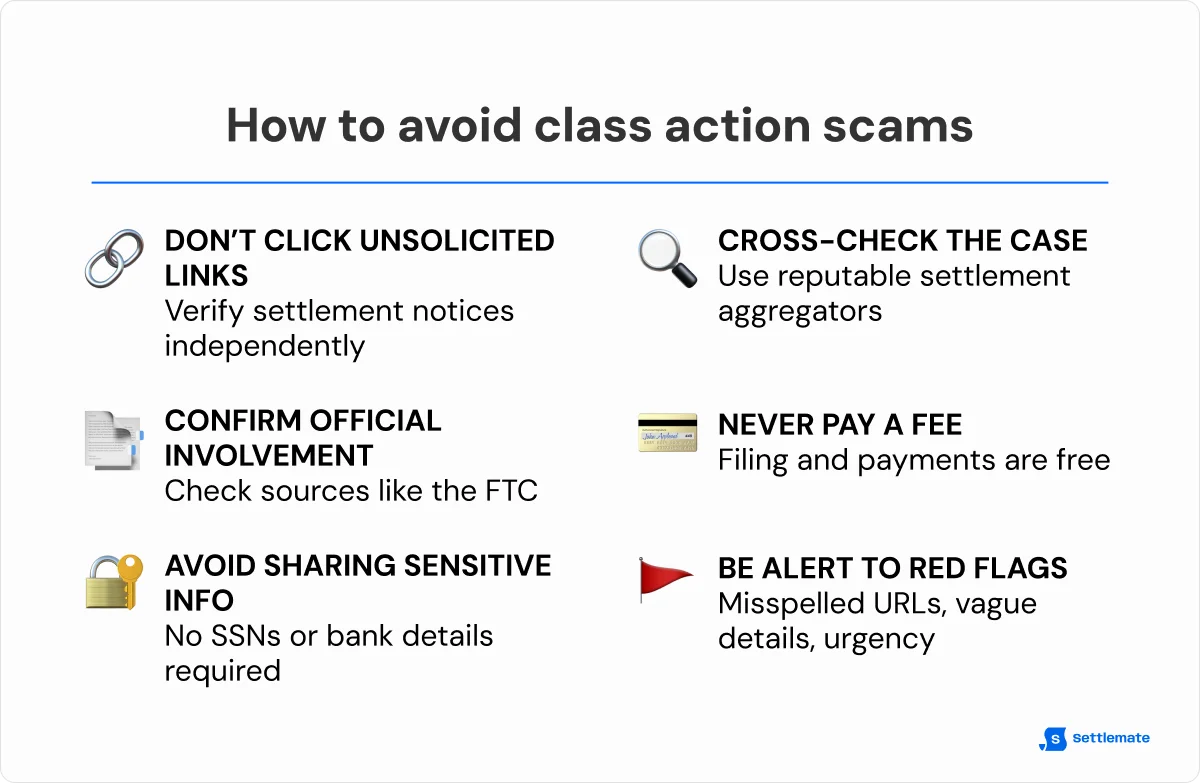
- Pay a fee to file or receive a settlement payment
- Share your sensitive data, such as full Social Security numbers or bank details
- Trust websites with misspelled URLs, vague case details, or artificial urgency
Pro tip:
Manually searching for class action settlements—and double-checking each one to avoid scams—gets exhausting fast. That’s why many people stop looking long before they ever file a claim.
A better approach is to use a tool that does the searching and verification for you.
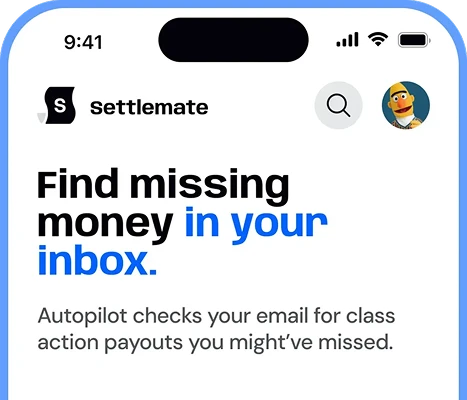
Settlemate automatically scans for active and legitimate class action settlements based on your purchases, accounts, and services.
It’s designed to help everyday consumers recover money they’re owed, from data breaches and privacy violations to defective products and food recalls, all without the manual work.
If you prefer to review opportunities yourself before filing, Settlemate also maintains a dedicated section on its website listing active class action settlements.
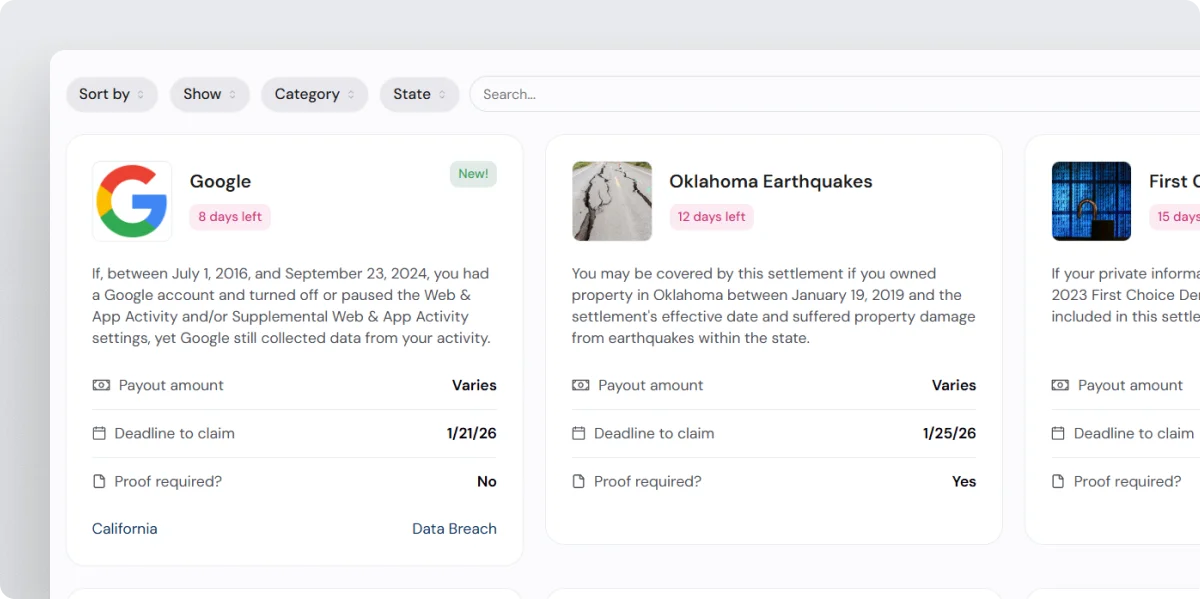
However, you can open any selected settlement directly in the app, so Settlemate still takes care of eligibility, submission, and follow-up.
Step 2: Check whether you’re eligible for the settlement
Not everyone affected by a company’s actions automatically gets a settlement check. Each class action includes a class definition that spells out exactly who qualifies.
If you don’t meet those criteria, you won’t get paid, even if you were affected.
Below are the most common eligibility requirements you’ll see across class action settlements.
Step 3: Review the payout details and claim requirements
If you’re looking into how to get money from a class action lawsuit, your main interest is probably cash. While this is fair, cash isn’t the only form of compensation used in class action settlements.
Other common compensation types include:
- Refund or reimbursement: Previously charged fees or costs are returned to you, such as hidden bank fees, flight-related charges after a cancellation, or overpayments later corrected through a price adjustment refund.
- Credits, vouchers, or coupons: You receive store credit or discounts toward future purchases instead of cash.
- Replacement or repair: A defective product is replaced or repaired at no cost.
- Service credits or account adjustments: Your account balance is credited, or future bills are reduced.
- Corrective services or support: The company provides training, updates, or assistance to address the issue that led to the lawsuit, such as instructional programs, software updates, or usage guidance.
That’s why it’s important to review the settlement details carefully before filing. Otherwise, you may spend time on a claim that doesn’t offer meaningful compensation for you.
In addition to the payout type, you should always check:
- Whether you need to submit any proof
- When you must submit the claim
- How and when the payment will be issued
Step 4: Submit your claim correctly
Being eligible for a class action settlement doesn’t automatically mean you’ll get paid. In most cases, you must submit a claim to receive money.
Claim forms exist because requiring participation helps control fund distribution costs and ensures settlement money goes to people who actively want to participate.
The good news is that filing a claim is usually straightforward and requires no legal assistance. Most claims can be submitted online and take only a few minutes.
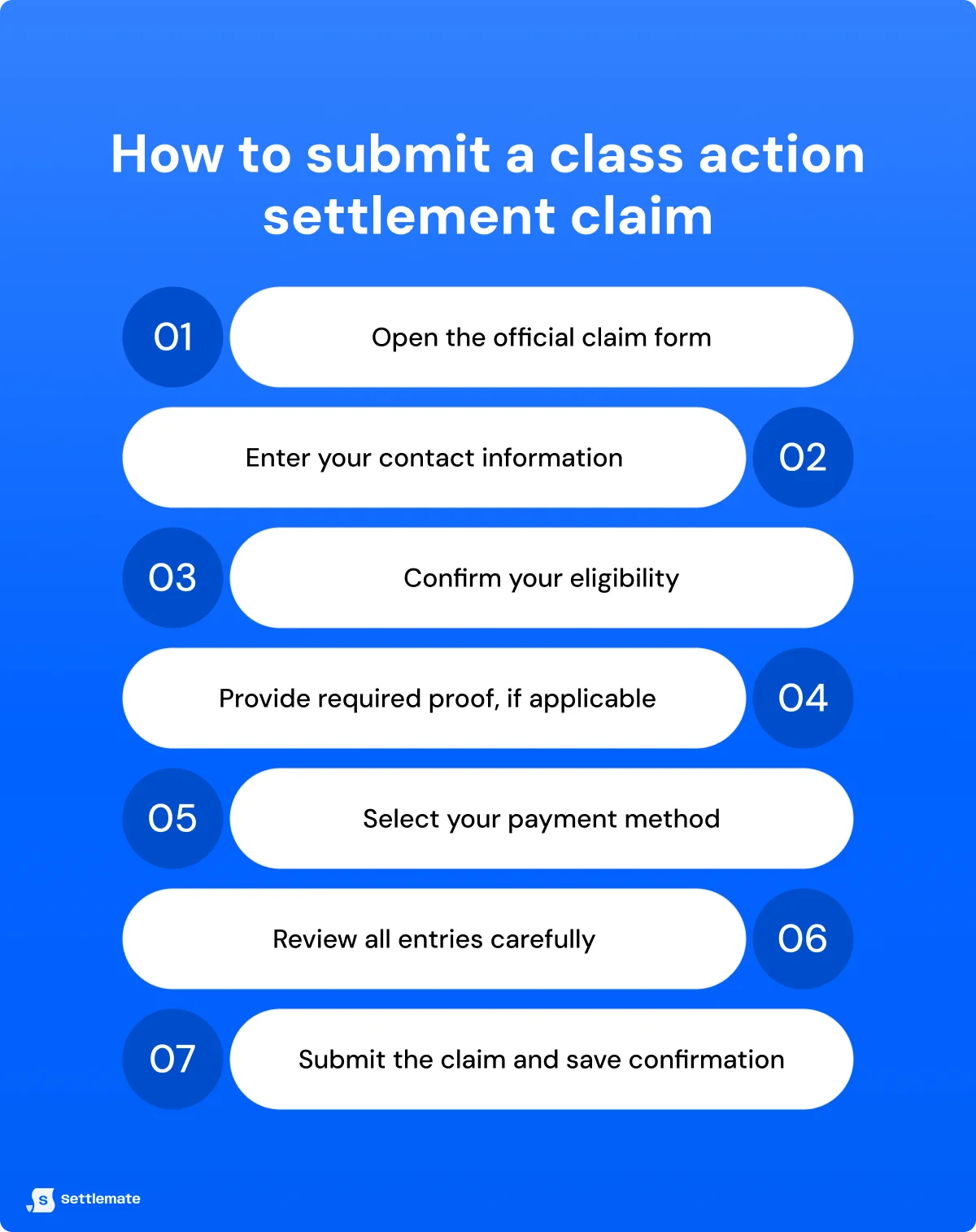
The process typically includes:
- Providing basic contact information
- Confirming eligibility (sometimes under penalty of perjury)
- Uploading proof, if required
That said, claims can still be denied.
Common reasons include missing documentation, incomplete forms, or information that doesn’t match the settlement requirements. That’s why you should double-check every field and attachment before submitting.
Beyond filling out the form correctly, timing is critical. If you miss the claim deadline, you receive nothing, even if you were eligible.
Step 5: Save confirmation and track your claim
Claims can stall, require follow-up, or be rejected. If you miss a request or deadline, you can forfeit your right to the payout without further warning.
To avoid this unfortunate scenario, you should track your claim.
At a minimum, you should:
- Save your confirmation email or receipt
- Record your claim ID or reference number
- Bookmark the official settlement website to check status updates
- Watch for follow-up emails requesting corrections or additional information
If you want to avoid manual checking altogether, Settlemate offers real-time claim tracking and smart notifications, so you can see status changes, payout updates, and deadlines as they happen.
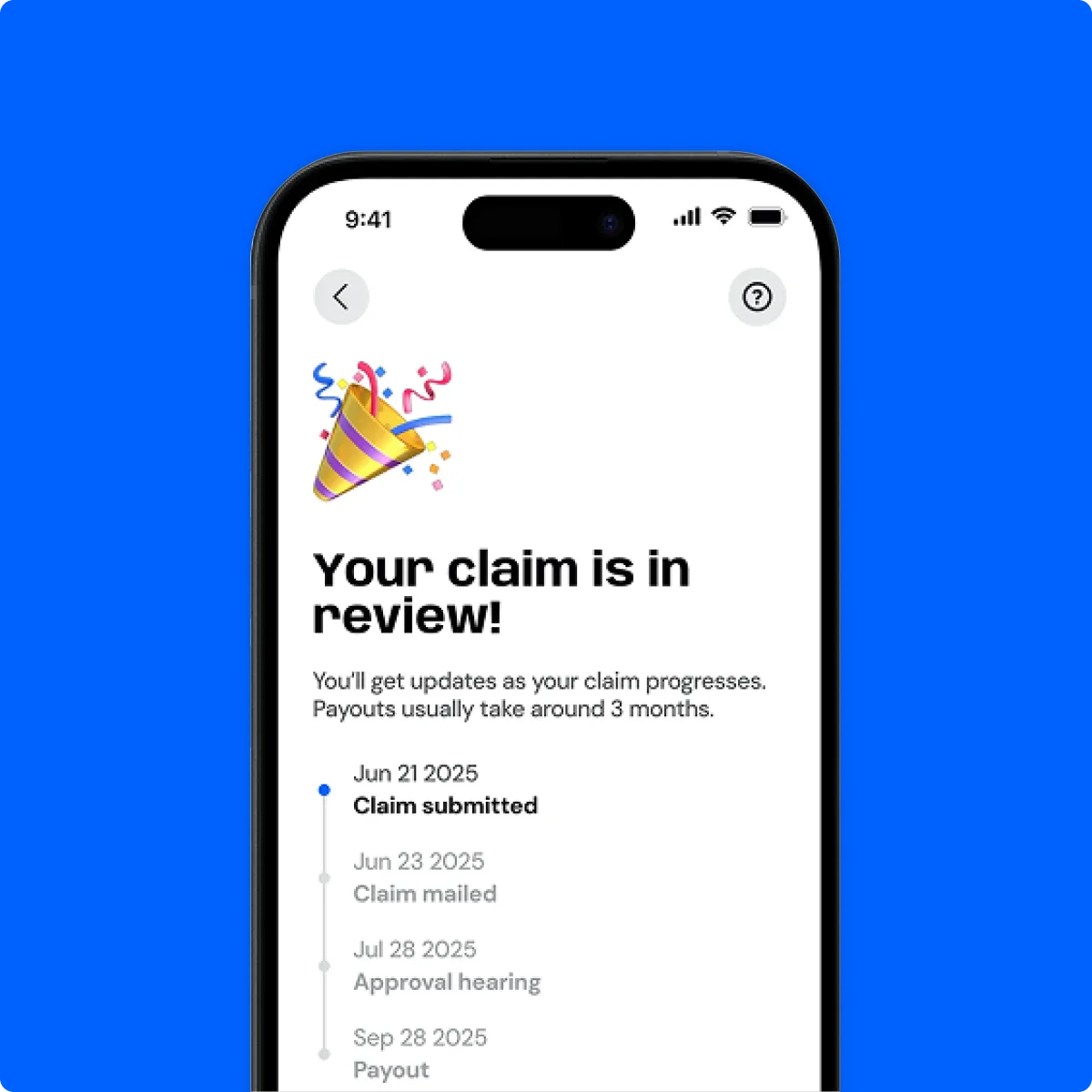
Step 6: Wait for court approval and processing
Once you’ve done everything required on your end, the rest is largely out of your hands. From here on, the court and the claims administrator control the timeline.
A typical post-claim process looks like this:
- Court approval: The judge reviews and approves the settlement terms.
- Claims review: The administrator verifies submitted claims and resolves any issues.
- Final calculations: Valid claims are tallied, and payout amounts are determined.
- Payment distribution: Funds are issued by check or electronic payment.
Class action payouts can take anywhere from several months to over a year, and in complex cases, even longer.
Common factors that can affect timing include:
- Court objections or appeals
- The volume of claims submitted
- Manual review or additional documentation requirements
- Outstanding liens or administrative processing delays
In other words, delays are normal. Staying patient and informed is part of the process.
Step 7: Receive your payment
After the settlement is finalized and your claim is approved, you’ll receive your portion of the payout.
Class action compensation is typically paid in one of two ways:
- Lump-sum payment: You receive your full payout at once, which is common for smaller or straightforward settlements.
- Structured payment: You receive compensation in stages or amounts that depend on factors like documented losses, claim tiers, or ongoing obligations.
The structure depends on the settlement agreement, the size of the fund, and the allocation of claims among class members.
Once the payout amount is determined, payment is issued using the method you selected when filing your claim, or the default method set by the settlement.
The table below outlines the most common payment methods and what to expect from each.
If you don’t receive payment by the expected date, don’t just assume it will come later. Instead, you should:
- Check the official settlement website for updated distribution timelines
- Search your email and payment apps in case you forgot the payment method you selected
- Contact the claims administrator to confirm your information and request a reissue if needed
Lost or expired checks can often be reissued, but only if you follow up. Staying proactive here is the difference between getting paid and missing out.
Step 8: Know the tax implications (if any)
Some settlement payments may be taxable, depending on what the money is compensating you for.
Compensation for physical injuries or sickness is often not taxable, while payments for lost wages, refunds of income, interest, or punitive damages are generally taxable under IRS rules.
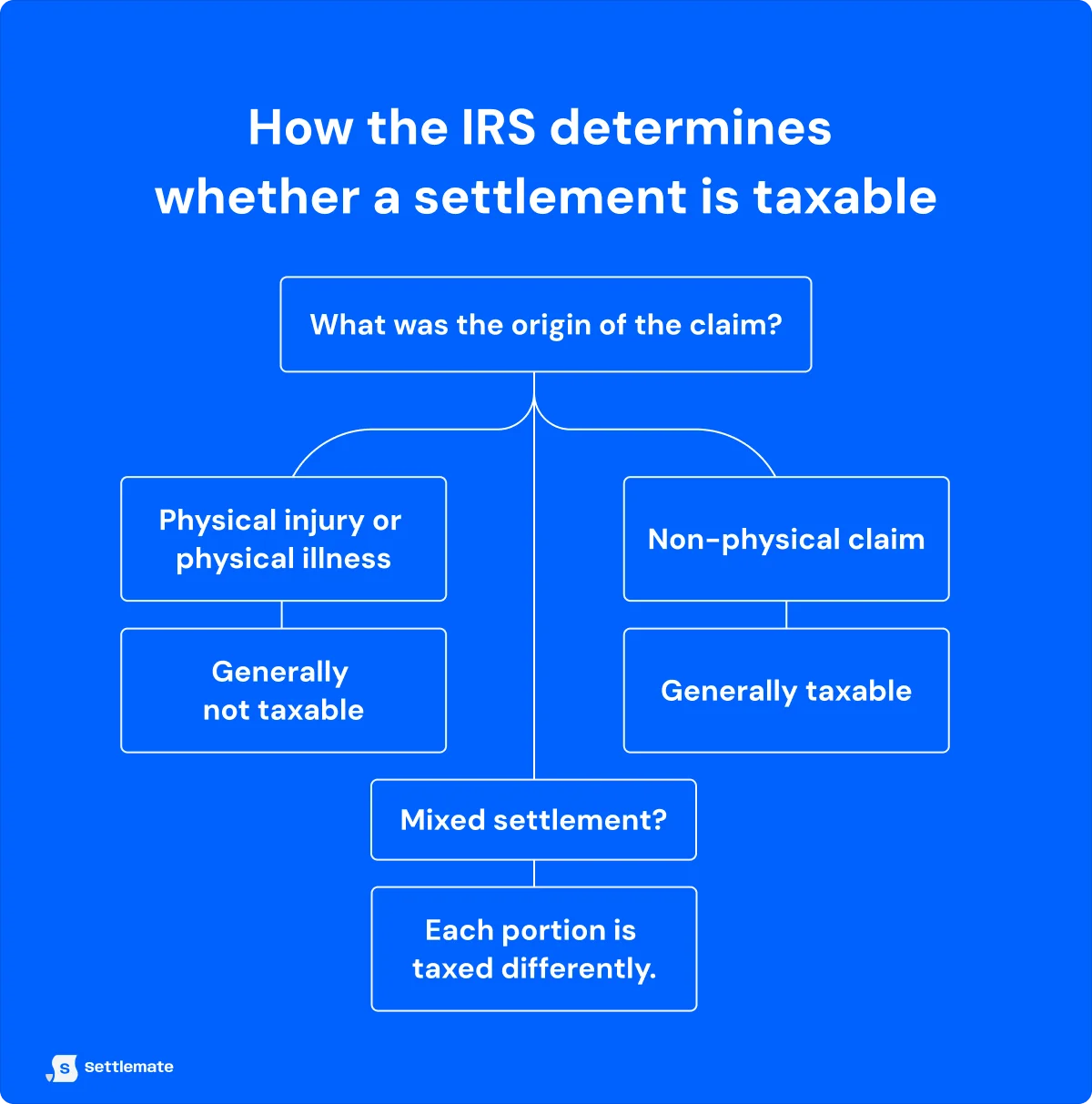
Larger payouts may also trigger tax reporting, so you could receive a tax form from the claims administrator.
Because tax treatment depends on the nature of the settlement—not just the amount—you should keep copies of your claim, payment notice, and settlement description in case the IRS questions how the payment was reported or requests clarification later.
If you’re unsure how a payout is treated, reviewing IRS guidance or checking with a tax professional is the safest move.
How to get money from a class action lawsuit the easy way
Class action payouts aren’t always huge, but they are still money you’re legally owed. So, if the choice is between doing nothing or letting a tool quietly stack those payouts for you, the math is simple.
With Settlemate, you can get money from class action settlements without hunting down cases, filling out paperwork, or worrying about scams.
The app covers all the bases, including:
- Finding claims automatically: Settlemate matches you to open settlements based on your purchases, accounts, and activity.
- Filing without a lawyer: The app completes and submits claims for you, with no legal forms or attorney fees.
- Tracking everything: It monitors claim status, deadlines, and payouts so nothing slips through the cracks.
- Alerting you in real time: Settlemate notifies you when new settlements open or your claim moves forward.
If you’re serious about getting money from class action settlements, download Settlemate on the App Store or Google Play and let it handle the rest.