

Receiving a class action settlement notice can be confusing. There’s a lot of information packed into a single letter or email, and most people don’t see lawsuits often.
The notice will tell you what the class action is about, why you’re included, and how long you have to file a claim. That part is usually straightforward, as settlement notices have to be written in plain English, so everyone can understand their rights and options.
The part that tends to throw people off is the random-looking string of letters and numbers included in the notice. That’s your unique settlement ID number, also known as a claim number.
This guide breaks down what a settlement ID number is, why it exists, and what you should do with it, so you don’t leave any money on the table.
Key takeaways
- A settlement ID number is your claim’s identifier
It is a unique alphanumeric code assigned by the settlement administrator to link your claim to you. It helps confirm eligibility, prevent mix-ups, and keep claims organized. - Only the settlement administrator can issue or look up your ID
If anyone else claims they can provide your settlement ID number, that’s a red flag. - Not every settlement gives you an ID right away
Some settlements issue ID numbers automatically, while others require you to register first. Not having an ID doesn’t mean you are ineligible or will receive less money. - Having an ID makes filing and tracking claims easier
A settlement ID number can speed up filing, help prove eligibility, allow you to update information, and let you check claim approval and payment status securely. - If you want to skip the manual work, Settlemate does it for you
Instead of tracking notices, ID numbers, and deadlines yourself, Settlemate automatically finds settlements you qualify for, files claims, tracks payouts in real time, and sends alerts when something changes. It’s the easiest way to make sure you don’t miss money you are owed.
Unique settlement ID number: The basics
A settlement ID number is exactly what it sounds like—an alphanumeric code that a class action settlement administrator uses to identify which class member the claim belongs to.
Each ID number is assigned to a single person and tied to the information the defendant already has on file, such as an email address, account record, or customer profile.
Who issues your settlement ID number?
A settlement ID number is issued by the settlement administrator. You shouldn’t expect or request this number from any other involved party, including:
- The court
- The defendant
- The legal counsel
- Claims websites
If anyone other than the settlement administrator claims they can issue or look up your settlement ID number, that’s a red flag. Only the administrator has the authority and the data to assign it in the first place.
The settlement administrator is a neutral, third-party company appointed by the court to manage the entire claims process. Their job is to track who’s eligible, who files a claim, and who gets paid. Assigning settlement ID numbers is a core part of that process.
The same party will also handle:
- Sending settlement notices to eligible class members
- Reviewing claim forms and approving or denying them
- Paying out settlement awards for valid claims
- Running the official settlement website, including claim submission and case updates
Where is the settlement ID number located?
On a settlement notice, the settlement ID number is usually listed near the top of the page, often below the case name or headline and next to labels like “Settlement ID,” “Claim ID,” or “Claim number.”
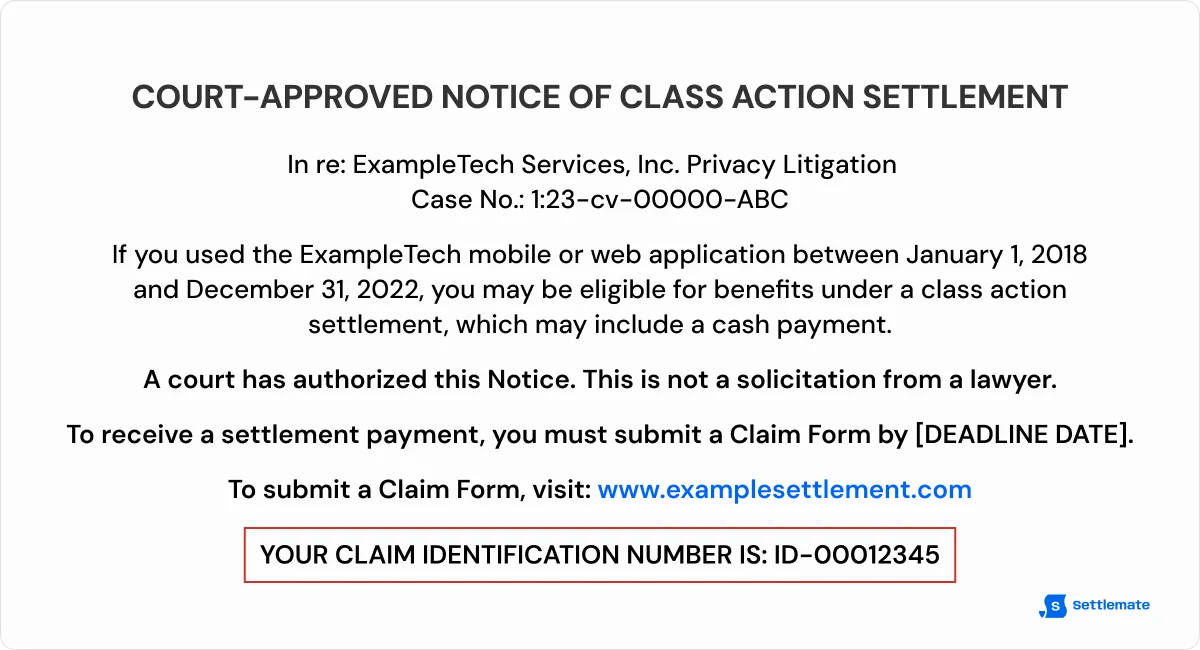
If the notice was sent by email, the number may also appear in the subject line or in the first few paragraphs of the message.
Settlement administrators place the ID number early in the notice so it’s easy to reference when filing a claim or contacting support.
After filing your claim or receiving your payment, you may also find the same number in a few other places, such as:
- Your settlement account or dashboard
- Payment or payout reports
- Your bank statement
Do all class action settlements include a settlement ID number?
Not every class action settlement uses settlement ID numbers, and even when they do, not every eligible person receives one automatically.
Settlement ID numbers are most common in large cases where administrators need a reliable way to track claims at scale. Whether you get one and when depends on how much information the settlement administrator already has about you.
Here’s how it typically breaks down:
What does your settlement ID number allow you to do?
Not having a settlement ID number doesn’t automatically hurt your claim or reduce what you’re owed.
In many cases, it just means you’ll need to enter a bit more information when you file. Plus, how much you get paid depends on the settlement terms and your proof, not whether you had an ID upfront.
That said, having a settlement ID number makes the process smoother and more efficient. Here’s what it lets you do.
1. File a claim
If you received a settlement ID number, you’ll usually need to enter it when filing your claim. This number helps prefill your information and speeds up the submission process.
Don’t worry; using your settlement ID number doesn’t expose your personal information.
The same security measures that protect claim forms apply here, and settlement administrators are required to follow state and federal privacy and data-protection rules when handling your information.
2. Prove you’re eligible
Your settlement ID number serves as proof that you’re a confirmed class member. It links your claim to the records the settlement administrator already has, reducing the risk of delays or rejection.
3. Update or recover your information
When you have a settlement ID number, the settlement administrator can quickly locate your claim if you need to update contact details, fix a mistake, or recover a lost submission.
If you misplace the number itself, the administrator can usually help you retrieve it through the official settlement website or support channels.
4. Track your claim and payment status
You’ll often need your settlement ID number to check whether your claim was approved and to see when payment is expected.
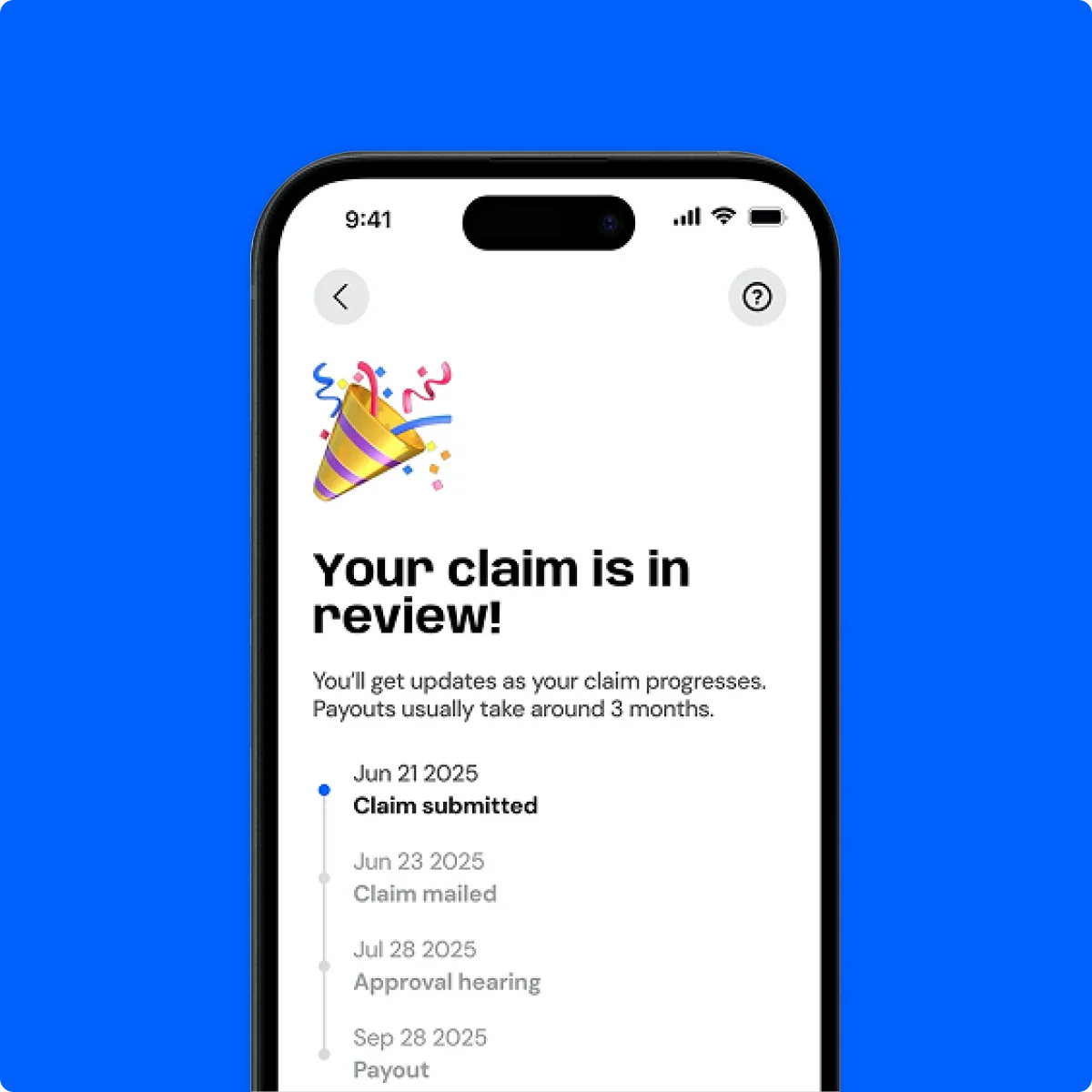
However, if you don’t want to spend time logging into settlement websites or typing in ID numbers, you can use an automated app like Settlemate instead.
Settlemate tracks settlements for you in real time, shows live updates on claim status and payout estimates, and sends smart notifications when something changes, so you always know where you stand without having to check manually.
Why administrators use settlement ID numbers
So, a settlement ID number helps you file, manage, and track your claim—but it also plays a critical role behind the scenes.
Here’s why settlement administrators use ID numbers.
1. Collecting accurate information
Settlement ID numbers allow administrators to collect and verify accurate contact information for class members. This ensures each claim is tied to the right person and reduces errors caused by incomplete, outdated, or mismatched records.
2. Keeping track of claimant documentation
Thanks to settlement ID numbers, administrators can manage records securely and maintain clear audit trails. It’s a simple way to keep complex settlements organized and defensible.
In practice, the ID number helps administrators:
- Validate claims and supporting documents
- Store and manage records through secure systems
- Track claim status and payment details
- Meet court and compliance requirements
3. Making the claims process more efficient
Even when real money is on the table, most people never file a claim.
Studies show that claim participation is consistently low, with rates topping out at 9% in FTC-studied consumer class actions where direct notice was provided.
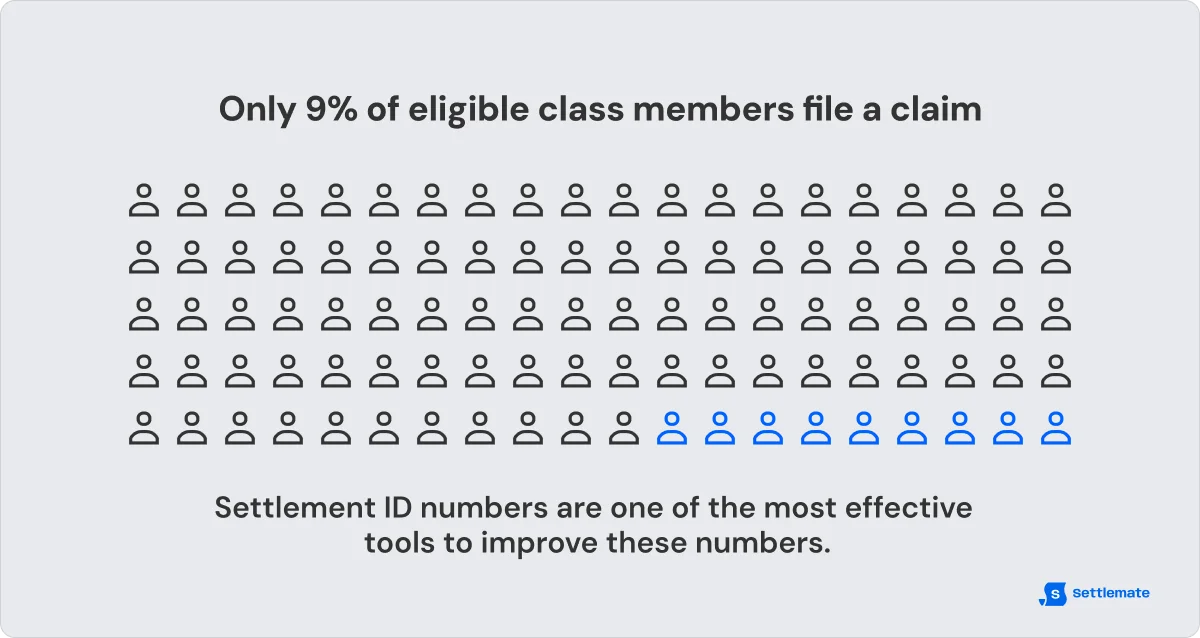
Settlement administrators are under increasing scrutiny to improve these numbers, and one of the most effective tools they use is the settlement ID number.
By assigning a unique ID to each class member, administrators can streamline claim submission, reduce friction, and eliminate unnecessary steps, making it easier for people to file correctly and on time.
4. Enabling targeted follow-up and reminders
Another proven way to raise claim participation is direct follow-up with class members.
In at least one consumer product liability settlement, reminder emails sent to registered class members led to roughly a 10% increase in claims filed, which is a meaningful improvement in a process where participation is typically stuck in the single digits.
When an administrator has a verified ID tied to contact information, follow-up can include:
- Reminders to complete a claim if someone started it but didn’t finish
- Confirmations that a claim was received, processed, approved, or denied
- Requests for additional documentation to fix or complete a submission
- Updates on court delays or case status changes
- Notifications when payments are issued
Because the outreach is tied to verified class member IDs, it’s more accurate and far more cost-effective than broad advertising or guesswork, helping administrators boost participation without wasting time or money.
5. Helping prevent fraud
As more settlements move online and make claims easier to file, fraudulent submissions have surged, driven by bots, automation tools, and fake documentation. In some cases, settlements have even been paused or reworked after claims far exceeded the number of products ever sold.
This puts everyone at risk: legitimate claimants, administrators, courts, and defendants.
Settlement ID numbers are one of the most effective tools administrators use to address this problem.
By tying each claim to a unique identifier, administrators can:
- Detect duplicate or automated submissions
- Verify claims against known class member data
- Flag suspicious patterns early
- Protect legitimate claimants from dilution or delays
In short, settlement ID numbers help separate real claims from fake ones, so the people who are actually owed money get paid.
Settlemate: A simpler way to handle settlements
A settlement ID number is a powerful tool for both filing your claim and keeping massive settlements organized behind the scenes.
But using this number also means you have to find the notice, keep track of the ID, monitor deadlines, and check multiple settlement websites to make sure nothing slips through the cracks.
If you’re looking for a less manual and error-prone way to claim what you’re owed, Settlemate does the heavy lifting for you.
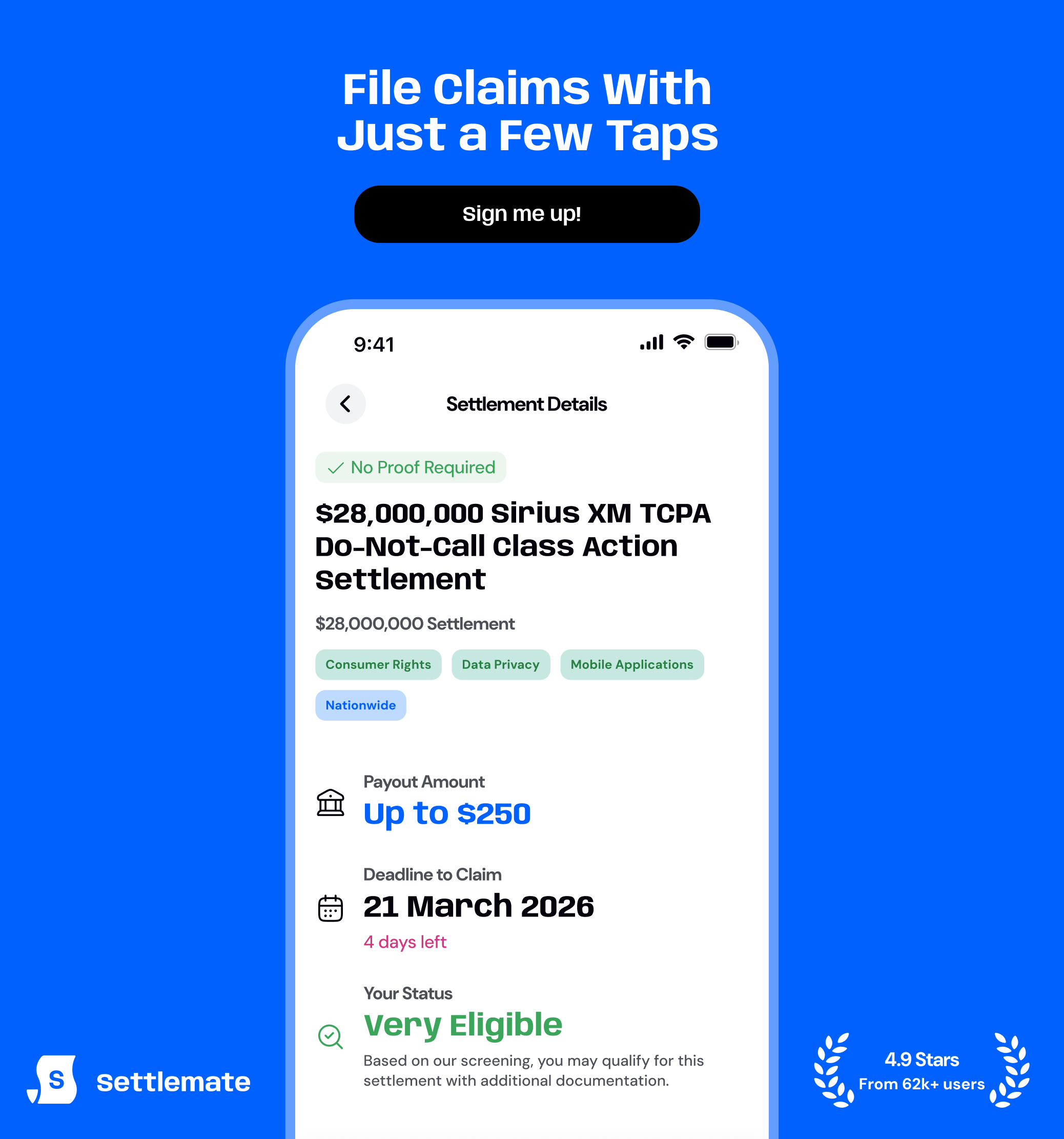
This consumer fintech app helps you find, file, and track settlement money securely and with almost no effort.
Here’s what Settlemate does for you:
- Automatically finds money you’re owed by scanning for eligible class action settlements, recalls, and refunds
- Files claims without lawyers or paperwork, directly from your phone
- Tracks claims in real time, including status updates, payout estimates, and deadlines
- Sends smart notifications, so you never have to check settlement sites manually
- Keeps your data secure, with encrypted access and no sharing without consent
- Handles receipts and emails for you, eliminating manual entry and lost notices
Download Settlemate on the App Store or Google Play and let the app do the work, so you can just get paid.