

Many people have been part of a settlement class without ever realizing it. The $425-million Google lawsuit alone pulled in nearly 100 million people.
Class actions cast a wide net, but eligibility means nothing if you don’t recognize it on time.
That’s why this guide breaks down exactly what a settlement class member is, how to know if you’re one, and what it takes to actually claim your share.
Key takeaways
- A settlement class member is someone the court formally recognizes as harmed and entitled to compensation
Once a judge certifies a class and defines who qualifies, anyone who fits that definition becomes a class member. This can include people affected by defective products, false advertising, data breaches, wage violations, or hidden fees. - You become a class member only after the court certifies the class
A lawsuit doesn’t create class members on its own. The judge must confirm that the group is large enough, has suffered the same type of harm, and is fairly represented. - Notices are the main way people learn they’re included, but many never see them
Direct notices go out when companies can identify consumers through accounts or purchase records. Indirect notices appear in ads and online when buyers can’t be tracked. - You’re usually included automatically unless the case requires you to opt in
Most consumer class actions pull you in by default and allow you to opt out if you want to pursue your own lawsuit. Wage-and-hour cases under the Fair Labor Standards Act often require an opt-in, meaning you must sign and return a form before becoming a class member. - Settlemate helps you avoid missed settlements and claim your money faster
Instead of hunting through notices or legal sites, Settlemate scans your purchase history and inbox to flag every settlement you qualify for. It alerts you instantly, auto-fills your claim forms, and tracks your payouts.
What is a settlement class member?
A settlement class member is someone the court formally recognizes as part of the group harmed by a company’s actions and, therefore, entitled to a share of the settlement.
The harm in question can come from almost anywhere: a product you bought, data a company mishandled, wages you were never paid, or prices rigged behind the scenes.
The table below summarizes the most common ways people end up as class members:
How courts decide who qualifies as a settlement class member
Even if a lawsuit is filed “on behalf of a class,” it doesn’t become a real class action—and you don’t become a settlement class member—until a judge signs off. Here’s how that works, step by step.
1. Someone files a lawsuit as a proposed class action
An individual (or sometimes a company) files a lawsuit claiming a defendant’s behavior harmed a whole group of people in the same way. This person is the proposed class representative.
Their complaint includes a proposed definition of who’s in the class, such as all U.S. residents who bought X product between 2019 and 2024.
At this stage, it’s just a proposal. No one is an official class member yet.
2. The lawyers ask the court to certify the class
The plaintiff’s lawyers file a motion for class certification; they ask the judge to approve treating the case as a class action instead of thousands or millions of individual lawsuits.
This is where the court begins deciding who qualifies as a settlement class member.
3. The judge checks if the group is big enough
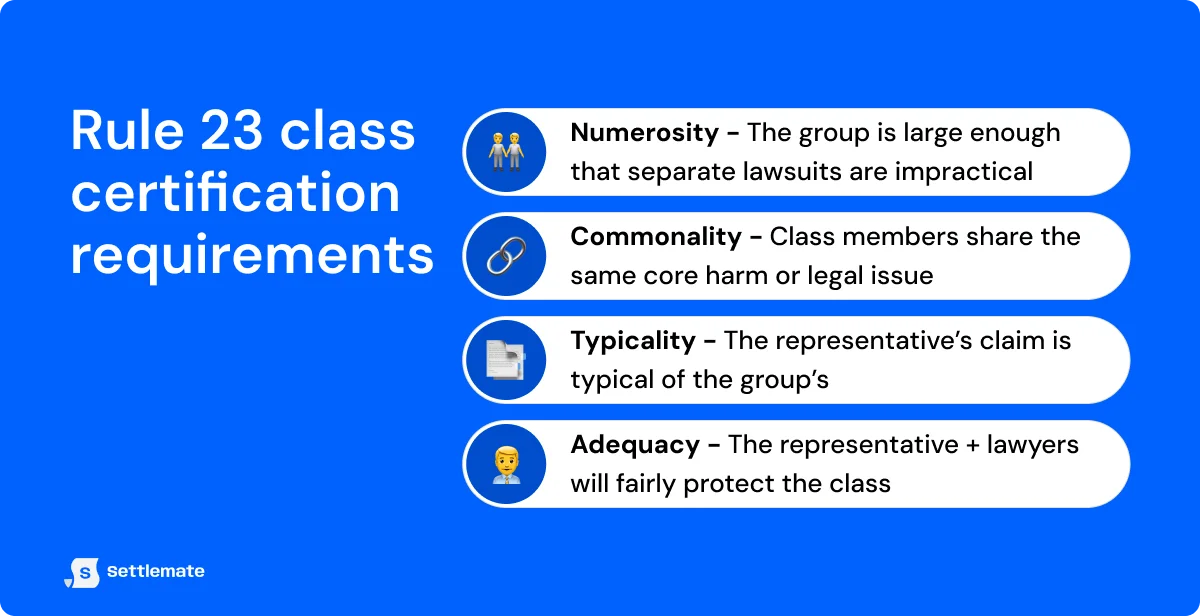
One key requirement for certifying the class is numerosity.
As per Rule 23 of the Federal Rules of Civil Procedure, there must be so many affected people that it’s impractical for all of them to file separate lawsuits.
4. The judge checks whether everyone suffered the same kind of harm
Commonality is another crucial factor for certifying the settlement class. In practice, that means the core injury and legal issue are the same for all class members.
If each person’s situation is too different, it’s not a good fit for a class action. That’s why video game addiction lawsuits are still mainly filed individually—the experiences and harms vary too widely from one person to another for a court to treat them as a single class.
5. The judge checks if the representative’s claim is typical of the group
The next requirement for the class certification is typicality.
The class representative’s claim has to be typical of the claims of everyone else in the class, not a strange outlier. If the lead plaintiff’s situation is too unique, the court won’t use them to stand in for everyone.
6. The judge decides if the representative and lawyers will fairly protect the class
Finally, the court looks at adequacy, seeking to answer two main questions:
- Will the class representative fairly and adequately protect the interests of the class?
- Are the class lawyers qualified and free of conflicts?
A corporation can serve as a lead plaintiff, but more often it’s an individual consumer or employee. Corporations are usually on the other side of the lawsuit.
Either way, the judge has to be satisfied they’re a fair stand-in for everyone they’re asking to represent.
7. The court issues a certification order and defines the class
If all the necessary requirements are met, the judge certifies the class. The certification order officially:
- Defines the class (who is in, by objective criteria like dates, purchases, locations)
- Defines the class claims, issues, or defenses
- Appoints class counsel (the law firm(s) that represent the class)
Only after this order do people become legal settlement class members.
Keep in mind that the judge can change this order before the case ends. They can narrow the class, redefine it, or even decertify it. If that happens, the court requires the lawyers to notify the affected group.
How to know if you’re a settlement class member
Federal Rule 23 requires the parties in a class action to notify every identifiable settlement class member. In other words, once the court approves a class, the lawyers must make a real effort to reach everyone who’s owed money.
However, not everyone sees the settlement notice in time. Emails get ignored, mailers look like junk, and plenty of people never realize a settlement even exists. That’s why the average claim rates for lawsuits whose class members are notified via postcards and email are about 6% and 3%, respectively.
With this in mind, let’s break down every way you can confirm you’re a settlement class member.
Receiving a direct notice
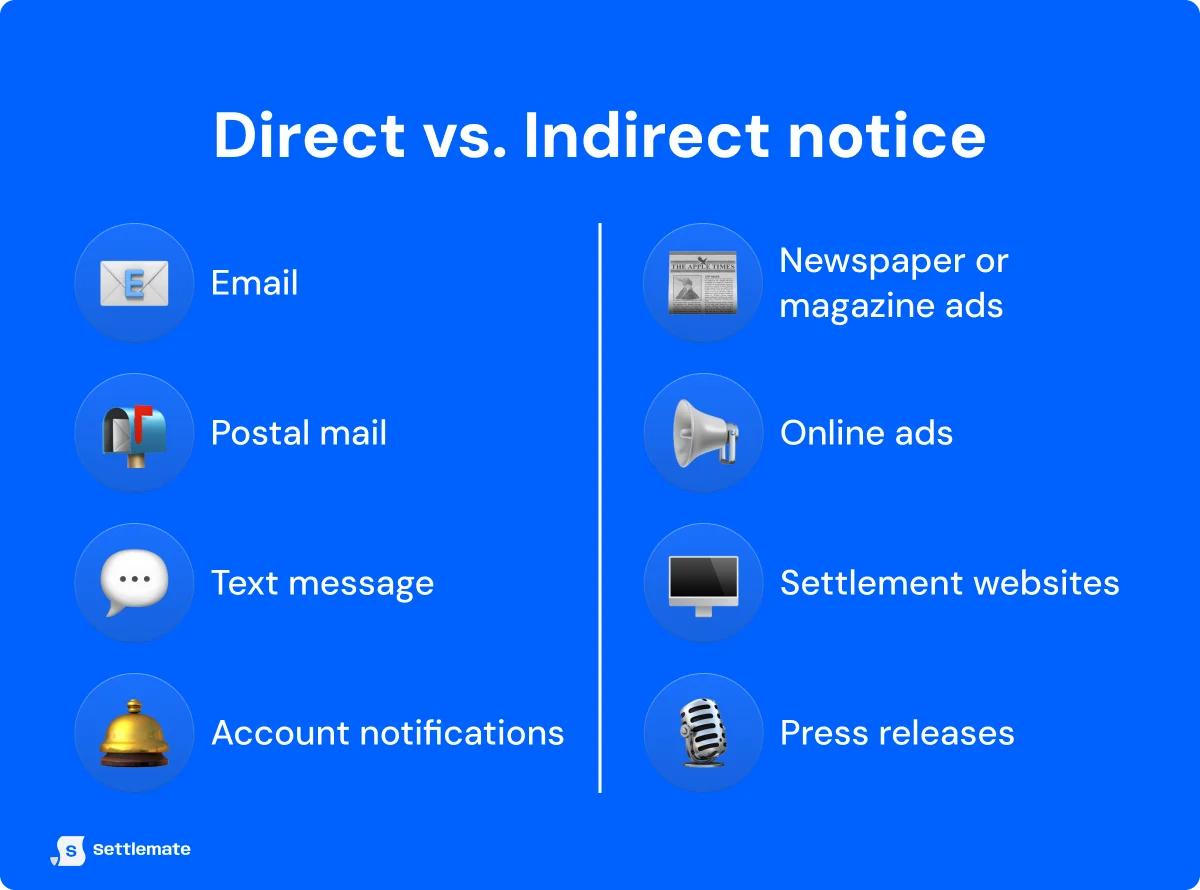
Courts require direct, individual notice when the defendant or lawyers can reasonably figure out who the class members are. This is common in cases where a company already has your information in its systems, such as:
- The company has an account relationship with you (cable provider, bank, subscription service, retailer with customer records).
- You registered a product, created an online profile, or made a purchase tied to your name or email.
- Employment records clearly show who worked where and when.
In these cases, the settlement notice is usually sent by:
- Postal mail
- Text message
- Account notifications or in-app messages
- Any other “individual notice” method that the court approves
Seeing an indirect notice
If it’s impossible to identify individual buyers, the court allows indirect or “publication” notice. This is how companies reach millions of anonymous consumers in cases like:
- Small, anonymous retail purchases with no customer data
- Products sold in grocery stores or big-box retailers with no registration
- Situations where tracking individual buyers would be impractical or impossible
A publication notice is typically delivered through:
- Newspaper or magazine ads
- Online ads (banners, social media, targeted digital campaigns)
- Settlement websites
- Press releases and public announcements
- Search engine ads aimed at keywords related to the product
Checking for notices yourself
If the notice never reaches you, you can still check whether you’re part of a settlement. Here are a few places where you should look:
- Online class action databases – regularly update new filings, settlements, and eligibility details
- State attorney general websites – often list major consumer actions affecting residents
- Official settlement websites – include the class definition and claim instructions
Using an automatic tool
If you don’t want to spend your time digging through notices and settlement sites, you can use an automatic tool that tells you when you’re a settlement class member.
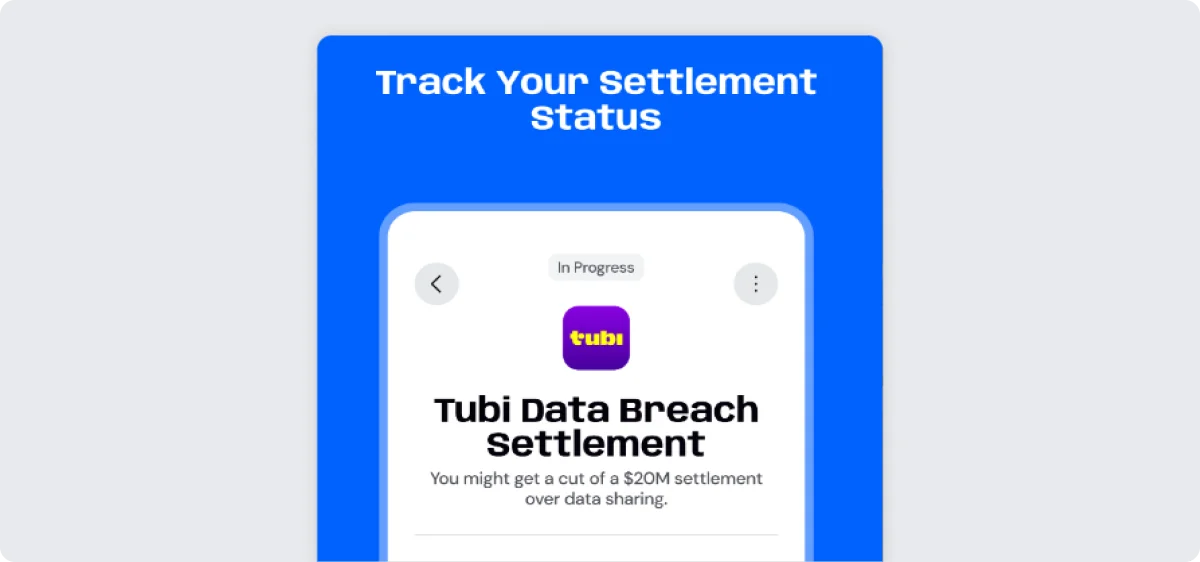
Settlemate scans your purchase history, email receipts, and its own settlement database to match you with every open class action case you qualify for. If a settlement includes you, the app flags it and notifies you instantly—no searching or manual checking required.
How do you become a settlement class member?
Becoming a class member doesn’t take much on your end. You’re either added automatically or asked to join.
Becoming a settlement class member automatically
In most class actions, you’re added to the class without doing anything at all. If you fit the court’s class definition—for example, everyone whose data was exposed in a specific breach—you’re automatically included.
That also means your legal rights are tied to the class unless you opt out.
Staying in the class gives you access to the settlement or trial outcome, while opting out preserves your ability to sue the company on your own.
Becoming a settlement class member by opting in
In collective actions, you must opt in to be counted as a class member.
This primarily refers to cases brought under the Fair Labor Standards Act (FLSA) or similar statutes that explicitly require employees to affirmatively join the lawsuit.
The classic opt-in situations include:
- Unpaid overtime
- Minimum wage violations
- Worker misclassification
- Certain large-scale workplace discrimination cases
In these cases, you become a settlement class member only if you sign the opt-in notice sent by lawyers and return the form to them.
Settlemate: An easier way to confirm you’re a settlement class member
Becoming a settlement class member is the first step to claiming the money you’re legally owed.
Settlemate helps you with this first step—and every step after it—through tools that automatically surface the settlements that include you.
This is made possible by:
- Instant eligibility matching: Settlemate scans its entire settlement database to show which cases you qualify for based on a few quick questions.
- Automatic receipt and inbox scanning: It identifies eligible purchases by parsing your email or uploaded receipts.
- Smart alerts for new settlements: You get notified the moment a new case applies to you, so you never miss a payout window.
- Auto-filled, lawyer-free claims: Settlemate completes and submits claim forms for you, cutting out paperwork and legal complexity.
- Real-time claim tracking: You can see payout progress, deadlines, and status updates in one place.
If you want zero-effort financial wins, download Settlemate for iOS or Android and start reclaiming what you’re owed.