


Class actions allow courts to resolve large numbers of similar claims through a single lawsuit and to distribute payouts evenly. Typically, eligible individuals are automatically included in the case and may receive compensation without filing separate lawsuits or hiring their own attorneys. For relatively small damages, the process is efficient and practical.
But if your damages are more significant or your situation doesn’t fit the mold, staying in the class could limit the compensation you may recover. Luckily, you have the option to opt out of most class actions and pursue your case separately.
This guide explains how to opt out of a class action lawsuit, what happens after you leave the class, and what factors to consider before deciding that opting out is the right move for you.
What does opting out of a class action lawsuit mean?
Opting out of a class action lawsuit or submitting a request for exclusion means you are removing yourself from the group of people collectively pursuing the case.
If you opt out correctly and before the legal deadline:
- You won’t receive any compensation from the class action: Once you opt out, you give up the right to any settlement or other benefits awarded through the class action lawsuit.
- You keep the right to pursue your own claim against the defendant: Opting out provides the opportunity to file an individual lawsuit that may lead to different compensation outcomes, which wouldn’t be possible if you remained a class member.
- You’re not bound by the outcome of the class action: If you remain a class member, you’re legally bound by the case’s final judgement or settlement, even if you disagree with the result. Opting out gives you the option to start your own legal action.
When does the class action opt-out right apply?
The ability to opt out of a class action depends on how the court certifies the class under Rule 23 of the Federal Rules of Civil Procedure. The structure of the case, not your preference, determines whether exclusion is even available.
Here’s what that means:
Note: In (b)(1) and (b)(2) cases, opt-outs are generally not available, but courts may allow them in limited circumstances to ensure a fair outcome for all parties involved.
How to opt out of a class action lawsuit: A step-by-step process
To opt out of a class action lawsuit successfully, you must follow the instructions provided in the class notice, submit a valid exclusion request, and meet the class action opt-out deadline.
The process consists of the following steps:
- Review the official class notice.
- Confirm the opt-out deadline.
- Follow the opt-out instructions carefully.
- Prepare your exclusion request.
- Submit your request using the approved method.
- Keep proof of submission.
- Verify your exclusion status.
1. Review the official class notice
After certifying the class, the court orders official notice to be sent to all potential class members. This notice serves as the official record for all class details you should review carefully, including:
- A summary of the lawsuit and the scope of its coverage
- Your right to opt out, if available
- The opt-out deadline
- Instructions for submitting a request for exclusion
- The legal implications of remaining in the class
- Contact details for the claims administrator
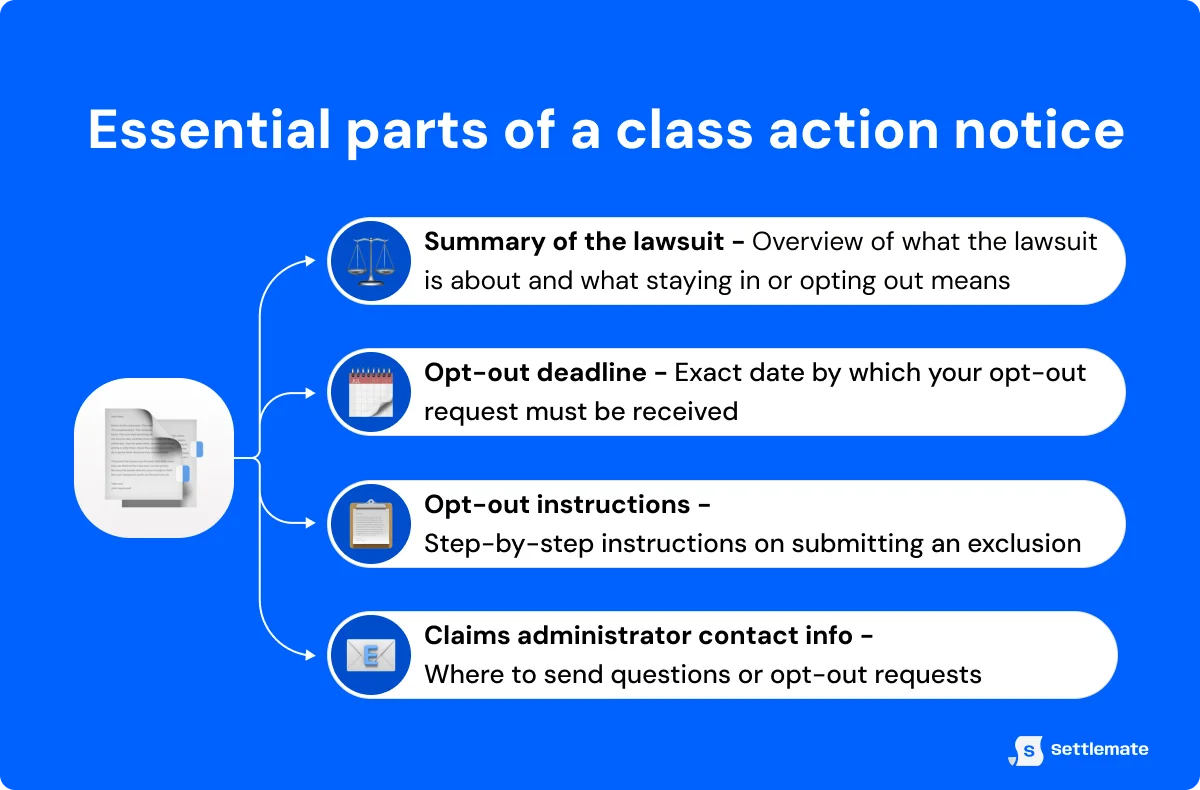
Every class action has its own rules, and the notice defines the specific requirements for a valid opt-out. Only after the class is certified and the notice (with potential opt-out details) sent out can you take the next steps to exclude yourself from the class.
2. Confirm the class action opt-out deadline
In most cases, your exclusion request must be received by the opt-out deadline, not sent by it. If your request arrives late, you will lose the ability to submit your own claim and will have to accept the outcome of the class action.
If you don’t receive the official class notice, you can usually find the deadline by checking:
- The official settlement website
- The claim administrator’s page
- Public court records
3. Follow the opt-out instructions carefully
Courts expect compliance with the instructions outlined in the official notice. Even small deviations can result in your request being rejected.
The notice determines:
- How to opt out: Mailing a form, emailing a written request, or using an online portal
- What information to include: Name, address, signature, class member ID, and a clear statement that you’re opting out
- Where to send your request: Specific mailing address, email address, or submission portal
- What formatting to follow: How to structure the request and which documentation to include
Pro tip: If the notice provides sample wording, use it. For example: “I request exclusion from the [Case Name] settlement.”
4. Prepare your exclusion request
Most class actions allow you to opt out in one of two ways:
- Completing a provided opt-out form
- Submitting a written request for exclusion
The form is a much more straightforward option because you only need to fill it out, sign it, and submit it by the specified deadline.
If you need to write your own request, keep it simple and precise. Make sure to include:
- Your full legal name and mailing address
- A clear statement that you want to be excluded
- The case name and number
- Your signature and date
5. Submit your request using the approved method
Send your opt-out request exactly as instructed in the official notice. Common methods include:
- Mailing it to the claims administrator
- Emailing a signed request
- Submitting through an online portal
Sending your request to the wrong address, using the wrong method, or missing required steps can invalidate your opt-out.
6. Keep proof of submission
Keep solid evidence that you submitted your exclusion request correctly and on time. If you’re sending your request by mail, use certified mail with tracking services.
Depending on the method you used to send the request, proof of submission can include:
- Courier confirmations (e.g., FedEx, UPS)
- Email delivery confirmations
- A copy of your sent email
- Upload confirmation
- Screenshots of online submission receipts, including the date and time
This documentation can prove useful if there’s ever a dispute about whether your exclusion request was received.
7. Verify your exclusion status
Some administrators send a confirmation notice once your opt-out request is processed, but not all do. If you don’t receive confirmation, you should:
- Check the settlement website for updates
- Contact the claims administrator directly
- Confirm that your name is no longer included in the class
This ensures your exclusion was properly recorded and you’re not unexpectedly bound by the outcome of the case.
What happens after you opt out of a class action lawsuit?
When you opt out of a class action, you give up any settlement benefits from the case in exchange for the ability to pursue your claim separately. Once your exclusion is accepted, you’re no longer part of the class, and the legal and practical implications take effect immediately. Read about what changes for you below.
Your statute of limitations resumes.
While a class action is pending, the statute of limitations for individual claims is generally paused for everyone who would fall within that class, as per the American Pipe & Construction Co. v. Utah case.
Once you opt out, the clock resumes. You only have the remaining time from the original limitations period to file your individual lawsuit. For example:
- Your claim originally had a two-year statute of limitations.
- The class action was filed one year after your claim arose.
- At that point, the clock stopped, with one year remaining.
- You have the remaining year to file your own lawsuit if you opt out.
Tolling protects individual claims, not new class actions. In China Agritech, Inc. v. Resh, the court clarified that this rule allows you to file an individual lawsuit, but you cannot start a new class action after the deadline has passed.
The exact way tolling applies depends on:
- Jurisdiction of your case (federal or state court)
- Type of claim (consumer, securities, employment, etc.)
- Specific court’s way of interpreting tolling rules
Because of this, calculating your deadline isn’t always simple, and you may need legal guidance.
You take full control of your case.
After opting out, you’re responsible for the next steps in your case, including:
- Hiring your own lawyer
- Filing a complaint in the appropriate court
- Gathering evidence and building your case
- Negotiating a settlement or going to trial
This autonomy can lead to better outcomes for high-value or unique claims, but it also requires more involvement and active decision-making.
You take on costs, effort, and risk.
Once you opt out, you take full responsibility for the legal and financial burden of pursuing your case. Depending on your situation, that can include:
Most importantly, you take on the risk of an unsuccessful outcome. If your case fails, you may not receive financial compensation, and depending on the fee structure, you might still be responsible for certain expenses.
Are class action opt-out rules different by state?
Most states have adopted rules that closely follow Federal Rule of Civil Procedure 23(b)(3). However, the states below have enacted variations that can affect whether a class member may exclude themselves from the class action:
- Massachusetts
- Arkansas
- Pennsylvania
- California
- New York
Can you opt out of a class action lawsuit in Massachusetts?
In Massachusetts, the class action procedure doesn’t provide class members the right to opt out.
The automatic notice is not required either. Instead, Massachusetts Rule 23 gives the court discretion to order notice in a manner it deems appropriate, including notice of:
- The pendency of the action
- A proposed settlement
- Entry of judgment
- Other proceedings
Courts often require notice to ensure due process and protect the interests of all parties, especially where failing to provide notice could create future res judicata issues.
Can you opt out of a class action in Arkansas?
Arkansas is more flexible regarding opt-outs. Class members have the right to exclude themselves from a class action if they’re not satisfied with the claims or remedies being pursued.
Arkansas courts also retain discretion to:
- Require a new opt-out opportunity at the settlement stage, even if one was previously provided.
- Refuse to approve the settlement unless affected class members are given a fair chance to opt out.
Can you opt out of a class action lawsuit in Pennsylvania?
Pennsylvania generally allows opting out of class action lawsuits.
The state modernized its class action framework with the new Rule 1711. In this state, the default rule is that all members of the defined class are included automatically unless they request exclusion by a specific deadline. This aligns with the federal Rule 23.
However, Pennsylvania law explicitly recognizes that the right to opt out isn’t absolute. Courts may restrict or eliminate exclusion rights in circumstances such as:
- When a defendant asserts a counterclaim against the class
- When the class involves joint rights, requiring mandatory joinder
- When unified resolution outweighs individual exclusion rights
Can you opt out of a class action lawsuit in California?
You can opt out of a class action lawsuit in California in most cases involving money damages.
California class actions are governed by California Code of Civil Procedure § 382. While the statute provides a basic framework, the detailed procedural rules for class actions are determined by case law and court practice.
California courts also have broad discretion over how official notice is provided and whether opt-out rights apply in specific contexts.
Can you opt out of a class action lawsuit in New York?
You can opt out of most damages class actions in New York, but courts closely supervise the certification, notice, and settlement process.
New York class actions are governed by CPLR Article 9, particularly CPLR § 904, which gives courts broad authority over notice and opt-out procedures.
The court determines:
- Whether notice is required at all
- How notice is delivered
- What information it must include
- Who pays for it
Opt-out procedures are tailored on a case-by-case basis, with judges evaluating practical factors such as the size of the class, the cost of notice, and whether the value of individual claims justifies active participation.
Real-world examples of successful opt-outs
Opting out of a class action doesn’t guarantee a better outcome, but it can lead to significantly higher recoveries for plaintiffs with substantial or well-documented losses. Below, you can see the examples of successful opt-outs:
When is staying in the class a better choice than pursuing an individual case?
While sometimes it may be smarter to step away from the class and pursue your own case, staying in the class is recommended when:
- Your claim is relatively small.
- Your situation is similar to everyone else’s.
- Your case may not be strong enough on its own.
- You want a simple, low-effort process.
- You don’t want to take on legal costs or risk.
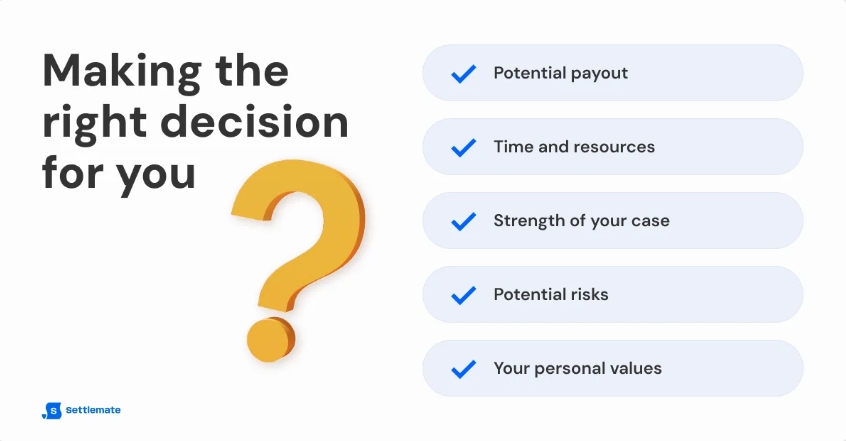
Class actions are the best option when potential compensation doesn’t justify pursuing the case individually. Broad cases, such as hidden fee disputes or health data breaches, are usually better suited for a class action lawsuit.
However, you can benefit from staying in the class only if you know the case exists. Although courts typically mandate that notice reaches every class member, this may not happen in practice, especially in massive cases involving millions of people, such as Schlesinger v. Ticketmaster.
Even when notices do arrive, they’re easy to misunderstand or ignore, particularly when you were not aware you were even eligible or compensation seems too low to bother. But miss a few dollars here and a couple of hundred there, and the amount piles up.
Relying on the notice alone isn’t enough, so you may benefit from an app like Settlemate. It tracks class actions for you, alerts you when you might be eligible for a claim, and highlights important deadlines so you can decide whether to stay in or opt out.
How Settlemate makes class action claims easier to track and file
Whether you stay in a class action or opt out, one thing is clear: timing and follow-through determine the outcome. Miss a notice, overlook a deadline, or skip a required step, and you can lose your claim even if you were fully eligible.
Settlemate provides operational support and ensures that doesn’t happen. Here’s how it works:
- Eligibility tracking: Settlement scans your inbox and shows you which active class actions you might qualify for.
- Deadline alerts: The app tracks key dates, including filing deadlines, exclusion windows, and updates, and sends reminders so nothing slips through.
- Centralized notices and documentation: Settlemate keeps all notices, updates, and claim details in one place so you’re always informed of the developments and requirements.
- Faster and simpler claim filing: If you decide to stay in the class action, Settlemate can pre-fill claim forms wherever possible. You review, confirm, and submit within minutes.
- Proof guidance: If a claim requires documentation, the app tells you what you need, so you don’t waste time guessing or risk submitting incomplete information.
How to get started with Settlemate

Getting started with Settlemate is simple.
Download Settlemate from the App Store or Google Play, create your account, and let Settlemate track class action lawsuits that apply to you.
There’s little risk in trying Settlemate thanks to our robust Value Guarantee. If your membership doesn’t deliver enough verified value to cover what you paid in your first 12 months, we’ll give you more time with complimentary extensions until you reach that value.
Frequently asked questions
If you have more questions about opting out of a class action, we’ve answered a few of the most common ones:
Do you need a class action opt-out lawyer?
You usually don’t need to hire an attorney to opt out of a class action. The process is simple enough to complete if you closely follow the instructions in the notice.
You may want to consult a lawyer if:
- Your claim is high-value or complex
- You’re considering filing an individual lawsuit
- You’re unsure about deadlines or statute of limitations issues
- Your situation is unusual and may not fit within the class definition
Should you opt out of the class action waiver?
Opting out of a class action waiver is different from opting out of a class action lawsuit. A class action waiver usually appears in contracts and requires you to give up your right to join a class action in the first place.
Whether you should agree to or challenge the waiver depends on the context. In many consumer or employer contracts, class action waivers are enforced by courts. But in other cases, they can limit your ability to bring collective claims and force individual arbitration instead.