


According to the Identity Theft Resource Center, there were 2,850 data breaches in 2024 alone, resulting in roughly 1.25 billion individual breach notices.
When breaches hit at that scale, you can’t afford to shrug and hope for the best. You need to be ready to protect your information, safeguard your accounts, and get compensated for the mess someone else created.
But claiming compensation isn’t always straightforward. Data breach litigation can be a maze of deadlines, legal jargon, and notices, which makes it easy to miss money you’re legitimately owed.
That’s why this guide offers 10 practical tips on how to claim compensation for a data breach—the real, actionable moves that put cash back in your pocket.
Key takeaways
- Verify the real scope of the breach
Don’t rely solely on the company’s notification. Cross-check press reports, regulator filings, and security researchers to understand what actually happened. Your compensation depends on the true impact, not the sanitized version you receive. - Document exactly what was exposed and how it affected you
Specific evidence carries weight. Identify whether financial data, government IDs, login credentials, or medical information were compromised. Pair this with logs of time lost, unusual account activity, and out-of-pocket costs. - Act fast when financial data is involved
Bank and card information is the first target for criminals. Change passwords, enable 2FA, freeze credit, and track accounts immediately. Quick action protects you and strengthens your claim. - Watch for class actions and regulatory activity
Many data-breach class actions form after FTC or state AG investigations, but notices often never reach consumers. Tracking regulator updates helps you anticipate lawsuits and understand your rights. - Use Settlemate to avoid missing payouts
Most people qualify for far more settlements than they realize. Settlemate finds eligible class actions, scans your receipts and inbox for matches, files your claims, and tracks your payouts, so you don’t leave money unclaimed.
Tip 1: Dig deeper than the breach notification
Per the FTC (Federal Trade Commission), companies must tell you when your data’s been exposed. But they’re only required to provide the basics, not every detail that affects your compensation.
That’s why you need to confirm whether you were actually affected and how serious the breach was.
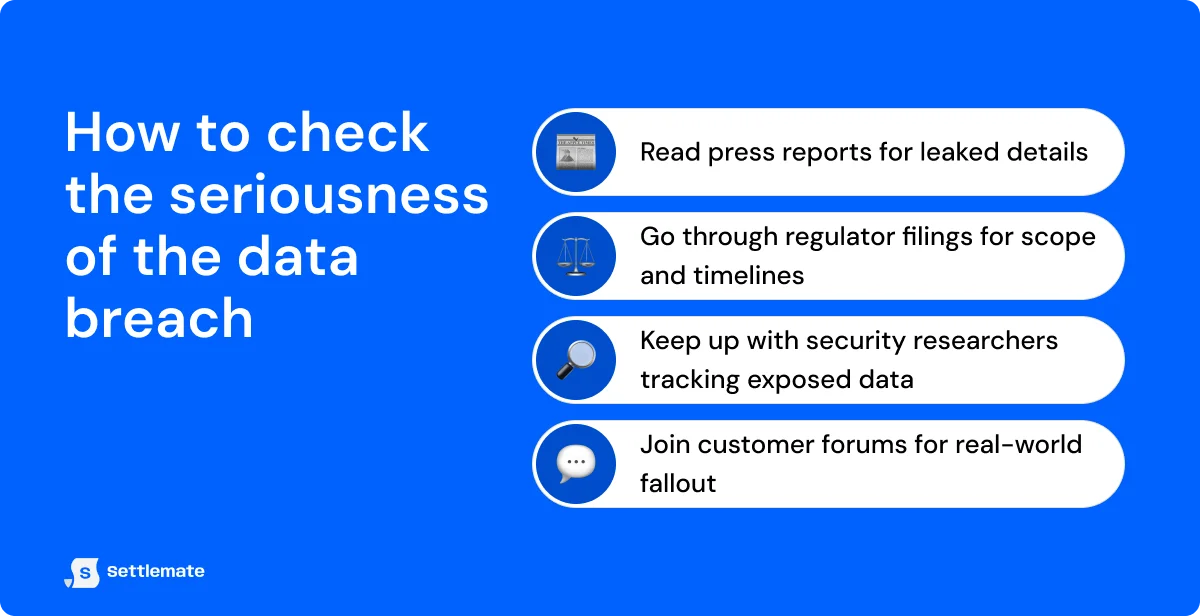
To do so, you should look beyond the notice and check out:
- Press reports for leaked details
- Regulator filings for scope and timelines
- Security researchers tracking exposed data
- Customer forums for real-world fallout
Getting the full picture matters because your compensation hinges on the real impact, not the version the company sends you.
Tip 2: Pin down the specific information that leaked
Evidence drives data breach settlements. If you can’t show what was actually compromised, your claim is weak before it even starts.
You need to be specific about which information the breach exposed because payouts depend on the type and sensitivity of the data involved.
Lock in the details by identifying whether the breach included:
- Financial information (bank accounts, credit cards, transaction history)
- Government IDs (SSN, driver’s license, passport numbers)
- Login credentials (emails, passwords, authentication data)
- Personal identifiers (full name, date of birth, address, phone number)
- Insurance or medical records
- Any unencrypted data that can be exploited immediately
The clearer you are about what was compromised, the stronger your standing, and the bigger your potential settlement.
Tip 3: Keep a detailed log of everything the breach costs you
The fallout of a data breach is rarely one-and-done. Depending on what was exposed, you might deal with password resets, suspicious charges, account locks, customer-service marathons, or new credit-monitoring chores.
While every one of these moments is more than inconvenient, you have to push past the frustration and write them all down.
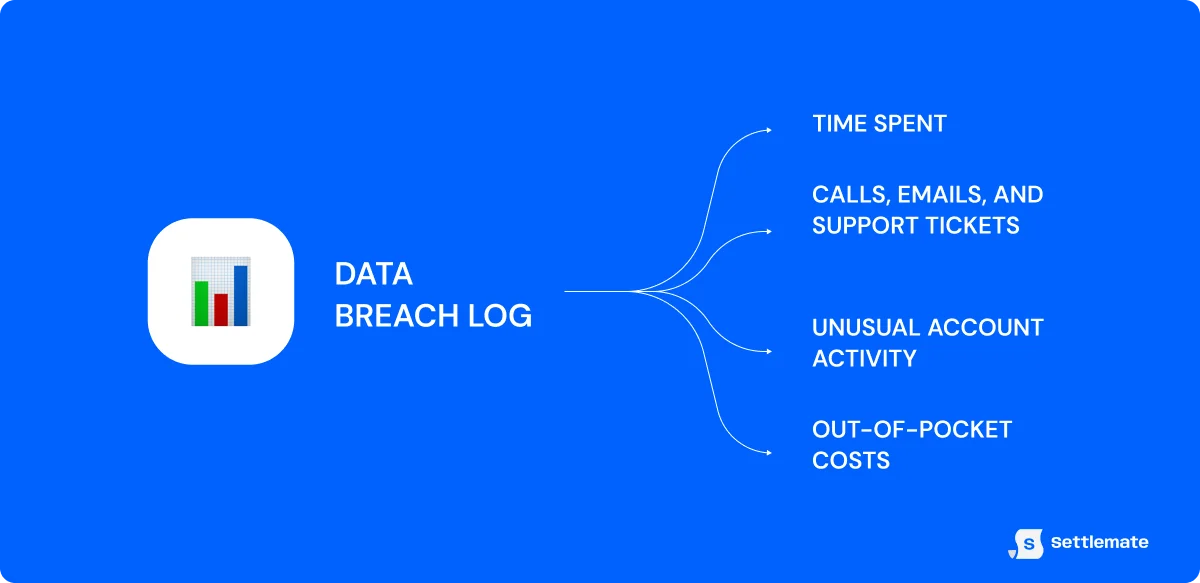
This includes logging:
- Time spent fixing issues or contacting banks and credit bureaus
- Calls, emails, and support tickets tied to the breach
- Unusual account activity you had to investigate
- Out-of-pocket costs like credit monitoring or fraud fees
- Any steps you took to secure your accounts or identity
The more precise your log, the harder it is for anyone to dispute the cost of the breach to you.
Tip 4: Note the psychological fallout as it happens
A data breach can cost you time and money, but don’t ignore what it does to your mental health. Don’t assume courts treat stress as “just part of it,” because they don’t.
Persistent worry, sleep issues, or the constant fear of someone misusing your information are recognized as real harm, and data breaches can trigger all of them.
If you’re forced to go through this, at least make it count by logging:
- Sleep disruption or trouble concentrating
- Anxiety when checking accounts or opening emails
- Worry about identity misuse
- Notes on how long symptoms last
Support your log with whatever evidence you have: medical visits, therapist notes, personal statements, or even a dated journal.
Tip 5: Screenshot anything that feels off
You might assume only “actual damage” helps you in a data breach lawsuit or class action.
However, suspicious activity—even if nothing ultimately stems from it—builds the pattern of risk that courts and settlement administrators look for.
That’s why you should screenshot anything that feels off, including:
- Password-reset emails you didn’t request
- Login alerts from new locations
- Unexpected two-factor authentication prompts
- Unusual bank notifications
- Messages asking you to “verify” information
But here’s the catch: screenshots alone are weak evidence. Courts usually treat them as illustrations, not authenticated proof, since they lack timestamps, metadata, and a chain of custody—all requirements under Rule 901 of the Federal Rules of Evidence.
The table below should help you make your screenshots stronger:
Tip 6: Pair different types of evidence for a stronger case
Courts and settlement administrators want clear, organized documentation, not random screenshots. When you pair different types of proof, you close the gaps and make your case harder to dispute.
Useful pairings include:
- Bank fraud alerts + your dated notes on what happened
- Suspicious emails + screenshots of related account activity
- Customer-service transcripts + identity-verification attempts
- Password-reset emails + login-location alerts
Store everything in a single folder, name files clearly, and date them. Layered, organized evidence signals credibility and pays off when your compensation is calculated.
Tip 7: Move fast if financial data was exposed
Financial services were the most attacked industry in 2024, with as many as 737 compromises. This figure makes sense since bank accounts, card numbers, and financial identities are instantly valuable on the black market.
If your breach involves any money-related data, you need to act fast. Timing directly affects both your risk and your eventual compensation.
Valuable steps to take include:
- Changing passwords on every financial account
- Turning on two-factor authentication
- Setting bank and card alerts for new charges or withdrawals
- Freezing your credit with Experian, Equifax, and TransUnion
If fraud appears, report it immediately and document every step. Courts look closely at prompt action, and fast mitigation strengthens both your safety and your claim.

Tip 8: Track regulator activity to spot class actions early
When it comes to data breaches, class actions are often the smarter path than filing alone. They move faster, require less paperwork from you, and spare you the lawyer fees.
While regulators don’t handle your compensation, they often signal when a class action is taking shape.
When the FTC or a state attorney general launches an investigation, it’s usually because the breach is serious—and serious breaches tend to trigger litigation. Checking FTC notices or state attorney general updates gives you an early read on the scope and timeline of the incident.
Besides awareness, you should leverage regulatory involvement to create your own official record. If your data was misused, filing a report at IdentityTheft.gov documents the incident, generates a recovery plan, and reinforces your credibility when joining a data breach class action.
Tip 9: Don’t assume you’ll hear about class actions
Data breach class actions are on the rise, with 1,488 filed in 2024 alone. Because many of these cases involve well-known companies, such as Cash App, T-Mobile, and Ticketmaster, you might qualify for far more settlements than you think.
But here’s the issue. Although companies are legally required to notify you about the breach, it doesn’t mean you’ll ever see that notice. Emails get buried in spam, physical mail goes to old addresses, and many companies tuck their disclosures into obscure compliance pages.
Instead of hoping you’ll catch every notice, you should use an automatic tool like Settlemate. It does the monitoring for you, flags cases you qualify for, and pre-fills your claim so you don’t leave money on the table.
Tip 10: Hold off on accepting goodwill offers
Settlement is the goal, but not at any cost. Companies often lead with “goodwill” payments that sound generous but massively undervalue the actual harm.
Before accepting anything, compare the offer to what similar breaches have paid. Does the breach involve minor contact info? Maybe fair. Financial or sensitive data? Almost always undervalued.
The manner of the breach matters, too.
Settlements tied to stolen unencrypted data or physical device loss often pay significantly more than routine hacking incidents. And if there’s evidence of actual identity misuse, that can shift the range even further.
The bottom line is that you shouldn’t let a fast payout undercut a legitimate claim.
In an individual lawsuit, that means negotiating instead of signing immediately. In a class action, it means objecting if the proposed settlement is unreasonably low.
Settlemate: The easiest way to claim your data breach settlement
When it comes to tips on how to claim compensation for a data breach, perhaps the most valuable advice is this: let go of as much of the grunt work as you can. The situation is stressful enough without you hunting down notices, parsing legal jargon, and filling out endless forms on every settlement website.
That’s why you should rely on Settlemate for data breach class actions.
Instead of you manually chasing every opportunity, Settlemate does the heavy lifting and turns “maybe I’m owed something” into actual claims by:
- Finding eligible data breach class actions tied to companies you actually use
- Scanning your inbox and receipts (with permission) to spot qualifying purchases and accounts
- Auto-filling and filing claim forms so you don’t touch the paperwork
- Tracking claim status and deadlines in one place
- Sending smart notifications when new, relevant settlements open or your claim moves forward
While you might be actively involved in one data breach lawsuit, Settlemate can work in the background to find money you’re already owed and help you claim it with almost no effort.
Download Settlemate on the App Store or Google Play and start turning data breaches into real compensation, automatically.
FAQ
Can you sue if your data is breached?
Yes. If a company failed to protect your private information, you can sue individually or join a class action. Most people qualify through class actions, which don’t require hiring a lawyer or paying legal fees.
How do I make a data breach claim?
Collect evidence of what was exposed, document any financial or emotional impact, and confirm whether a class action is open. Then file a claim through the settlement administrator. Tools like Settlemate can find eligible cases automatically and submit the paperwork for you.
How much compensation can I get for a data breach?
It varies widely. Minor data leaks may pay a small flat amount, while breaches involving financial, medical, or government ID data can pay significantly more. Factors like actual fraud, time spent fixing issues, and emotional harm can increase your payout.