

In November 2025, over 2,800 flights were canceled and 10,000+ were delayed across the U.S. after authorities reduced air traffic due to staffing shortages in air traffic control (ATC). Two years earlier, an issue with UK ATC led to over 2,000 canceled flights and many more delays.
Situations like these affect millions of passengers, and airlines’ explanations may sound frustratingly vague: your flight is canceled due to air traffic control. There’s no clear fault, next steps, or indication of whether you’re entitled to compensation.
This guide explains what it means if your flight gets canceled due to air traffic control, when you might be eligible for compensation, and how the rules differ internationally. You’ll also discover how Settlemate helps you claim all eligible payouts without doing the grunt work yourself.
Why do flights get canceled due to air traffic control?
When an airline says that your flight was canceled due to air traffic control restrictions, it means the decision came from the system that manages aircraft movement in the air and on the ground.
ATC is responsible for:
- Managing how many planes can safely take off and land
- Preventing congestion in busy airspace
- Responding to safety risks, weather, and technical issues
- Preventing accidents
- Providing information and support to pilots
Because of this, ATC can impose restrictions that may directly affect your flight. These include:
- Reducing airport capacity (fewer takeoffs and landings allowed)
- Grounding flights temporarily
- Delaying or cancelling flights to prevent overcrowding in the air
- Diverting flights to a different airport
From your perspective, it looks like a standard cancellation. However, your flight may have been removed from the schedule because the airport couldn’t handle more traffic, or safety limits were reached.
As a result, airlines often use “air traffic control restriction” as a blanket explanation.
Can you get compensation if air traffic control cancels or delays your flight?
Compensation is typically unavailable for delays caused by ATC restrictions.
ATC is managed by independent aviation authorities:
- The Civil Aviation Authority in the UK
- Eurocontrol in the EU
- The Federal Aviation Administration in the U.S.
- Transport Canada Civil Aviation in Canada
When these organizations impose restrictions, airlines are required to comply. Because these decisions are made externally and are tied to safety, airlines classify them as extraordinary circumstances or situations outside their control. That’s why compensation is usually denied.
However, you have mandatory care and refund rights, depending on your flight destination. Here’s what major passenger rights frameworks require:
Can you claim compensation for a canceled flight due to an air traffic control strike?
You won’t be eligible for compensation if your flight is canceled due to an ATC strike. That’s because ATC staff are employed by national aviation authorities, not airlines. When they strike, the disruption is treated the same way as other ATC-related restrictions.
Your right to a refund, rebooking, and basic care still applies.
However, if your flight is canceled due to a strike by airline staff, such as pilots, cabin crew, or ground personnel, you may be eligible for compensation.
Why you shouldn’t take “flight canceled due to air traffic control” at face value
When airlines say your flight was canceled due to ATC, it sounds like a clear-cut explanation. However, the context behind the decision is crucial.
A 2026 ruling by the Court of Justice of the European Union confirmed that an ATC decision can exempt airlines from paying compensation, but only if the airline wasn’t a contributing factor.
It means that the airline is exempt from paying if:
- There is a direct causal link between the ATC decision and your specific flight
- The disruption didn’t come from earlier operational issues within the airline
- The airline couldn’t have reorganized resources to avoid cancellation
This means you should review the chain of events and the airline’s response to ATC’s decision before evaluating your eligibility for compensation.
Why claiming airline compensation manually usually fails
Checking whether you qualify for compensation caused by ATC restrictions seems simple: you merely need to check whether your airline was a contributing factor. But that requires access to operational details airlines don’t volunteer.
Airlines control the narrative. When you submit a claim, they may respond with a standard “compensation is denied because the flight was delayed due to air traffic control.” You can challenge this, but without access to the evidence, it becomes difficult. And that’s even before you pinpoint which regulation applies to your case. It’s a lot to piece together, so most people don’t even pursue compensation.
Even when eligibility is clear, and everything should go smoothly, the claim process presents friction at every step, as you must:
- Interpret legal eligibility
- Gather supporting evidence
- Find the right channel to submit your claim
- Follow up repeatedly in case of generic denial
- Escalate to a regulatory body if necessary
Most passengers don’t have the time or energy to do that, so they give up mid-process, leaving money on the table.
It doesn’t have to be that way. Settlemate can automate every step, from detecting eligible disruptions to escalating claims and following up until resolution.
Recover what you’re owed with Settlemate
The hardest part when claiming airline compensation isn’t knowing your rights, but actually enforcing them.
Settlemate can do it for you. Instead of interpreting regulations, arguing with airlines, and chasing responses for weeks, all you need to do is download the app and connect your inbox. The system then automatically:
- Detects eligible disruptions from your bookings
- Applies suitable legal frameworks
- Prepares and submits the claim through appropriate channels
- Follows up and escalates when necessary
Settlemate will notify you about every step and ask for your input only when necessary. For example, it tells you what additional documentation to upload and prompts you to choose between options like a refund, a travel credit, cash payout, or a voucher.
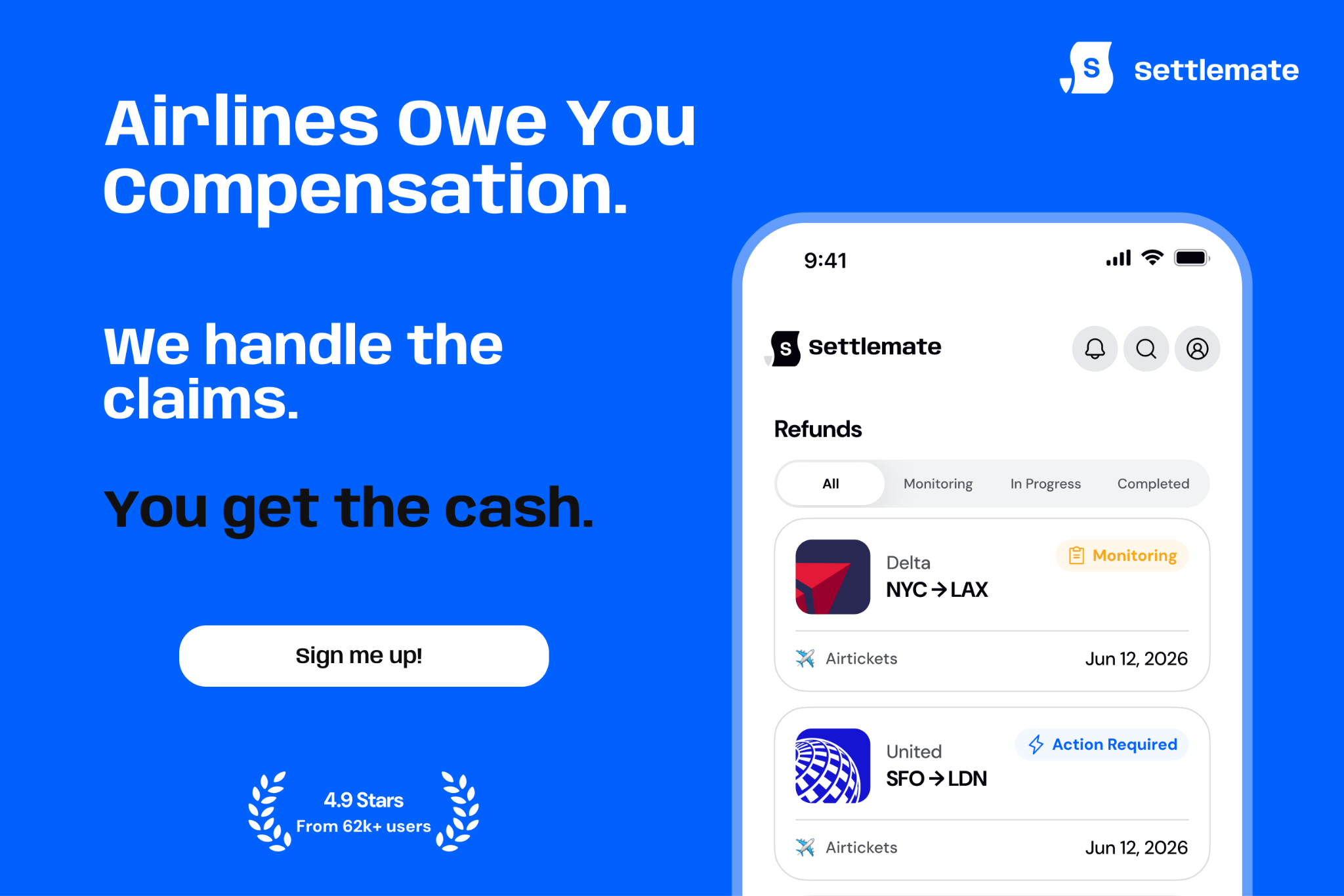
Download Settlemate via the App Store or Google Play and let Settlemate Retail Savings Autopilot turn flight disruptions into payouts.
Value Guarantee: If you don’t recover your membership fee through verified value in the first 12 months, we’ll extend your membership for another year at no additional cost. We’ll continue extending your access until the cumulative value you receive matches your original subscription fee.
What each airline owes you after a flight disruption
Each airline follows its own compensation policy, so your rights can vary. If your flight was canceled, delayed, diverted, or significantly changed, these guides can help you understand what you may be entitled to: