

We’ve all been there. You’re stuck at the gate, the departure time keeps changing, and no one from the airline is giving you a straight answer. Hours pass, plans fall apart, and your frustration starts to build. But should you just accept your bad luck, or can you be compensated for a delayed flight?
This guide explains when delayed flight compensation applies, how much you could receive, and what passenger rights actually protect you.
If you want to avoid the endless back and forth with the airline while claiming compensation, we’ll also explain how Settlemate can automate the whole claims process.
What is delayed flight compensation?
Delayed flight compensation is a financial or service-based reimbursement you’re entitled to when your flight is significantly delayed due to reasons within the airline’s control.
Delayed flight claims typically involve three types of compensation:
- Cash compensation: It’s the legally mandated payout you receive from the airline for the inconvenience and time lost, and it’s not tied to your actual expenses. This type of compensation may apply even if the airline rebooks you.
- Refunds: This is the reimbursement for the unused ticket that you receive when a delay becomes significant enough that continuing the trip no longer makes sense, or when the airline changes your flight schedule.
- Assistance and reimbursements: Assistance refers to meals, hotel accommodation, transportation, or communication means that airlines must provide during long delays. Reimbursements cover reasonable out-of-pocket expenses when the airline fails to provide this immediate “right to care.”
It’s important to distinguish airline obligations from supplemental travel insurance and credit card benefits. Airline compensation is based on passenger rights laws and airline policies. Travel insurance or credit card trip delay coverage typically reimburses out-of-pocket expenses, like food, hotels, and toiletries, after a delay. They don’t replace cash compensation owed by the airline, meaning you can often claim both.
Are you entitled to compensation for a delayed flight?
Whether you’re entitled to compensation for a delayed flight depends on four factors:
- Where you flew
- Which airline you flew with
- Why the delay happened
- How late you arrived at your final destination
There’s no universal rule that applies to every flight, which is why similar delays can lead to very different outcomes for different passengers.
For example, a three-hour delay on a flight departing from Paris on an EU airline could trigger cash compensation under EU law. The same three-hour delay on a domestic U.S. flight usually wouldn’t result in cash compensation, but might still qualify for a refund, rebooking, or meal assistance, depending on the airline’s policy.
If the delay was caused by extreme weather or air traffic control, compensation rules may not apply at all, while issues like staffing shortages or technical problems often qualify you for compensation.
Entitlement to flight delay compensation is based on specific legal frameworks that define passenger rights around the world. We’ll break down the four main ones:
- EU and UK regulation EC261
- Montreal Convention
- Canadian Air Passenger Protection Regulations (APPR)
- U.S. DOT rules
1. EU and UK regulation EC261
Under the EU and UK regulation EC261, you may be entitled to care, a refund, and cash compensation if your flight arrives significantly late and the airline is responsible, even if it eventually gets you to your destination.
EC261 covers you if:
- Your flight departs from the EU or the UK
- Your flight arrives in the EU or UK on an EU/UK airline
Important: Compensation depends on arrival delay, not departure delay. If you reach your final destination three or more hours late, cash compensation may apply.
Before cash compensation even comes into play, airlines must offer:
- Meals and refreshments
- Hotel accommodation and transport if an overnight stay is required
- Communication support
If the delay reaches five hours, you can also choose a full ticket refund instead of flying. You may also receive a refund for the completed parts of your journey if the flight no longer serves your original travel plan, along with a return flight to the first point of departure, if applicable.
Keep in mind: Airlines sometimes push alternatives like vouchers or travel miles instead of compensation. However, if you’re eligible for compensation, no airline can force an alternative. EC261 compensation is paid in cash, unless you explicitly agree to vouchers.
2. Montreal Convention
The Montreal Convention is an international treaty that applies to most international flights worldwide, including trips across the U.S., EU, UK, and 140+ other countries. Unlike EC261, the treaty doesn’t guarantee automatic cash compensation for delays. Instead, it protects you if a delay causes real, provable financial losses.
Under the Montreal Convention, you may be entitled to reimbursement for reasonable expenses caused by a delayed international flight, but only if you actually incurred costs. That means no flat payouts are available simply for arriving late.
These are the eligibility rules:
- The flight must be international.
- The delay must be caused by the airline, not your own actions.
- You must keep receipts.
- You must act reasonably (e.g., if the airline offers you a decent hotel and you book a five-star accommodation, the airline can argue that you acted unreasonably).
The airline will likely avoid liability if it proves that the delay was unavoidable and that it took all the necessary measures to prevent the disruption.
In this case, here’s what you can be reimbursed for:
3. Canadian Air Passenger Protection Regulations (APPR)
Canada’s APPR rules apply to all flights to, from, and within Canada (including connections) and cover both Canadian and foreign airlines. Your eligibility for flight delay compensation depends on why the disruption happened and how long it lasted.
If the delay was within the airline’s control and not caused by safety issues, you’re entitled to cash compensation, unless you specifically agree to a voucher instead.
Beyond cash compensation, airlines must also:
- Provide food, drinks, and communication means after a two-hour delay
- Offer hotel accommodation and transport for overnight delays
- Rebook you for free, including on a competing airline if necessary
You typically have one year to file a compensation claim, and airlines must respond within 30 days. If they deny eligible compensation, you can escalate complaints to the Canadian Transportation Agency, which can fine airlines up to $25,000 CAD per violation.
4. U.S. DOT rules
In the U.S., there’s no federal law that requires airlines to pay cash compensation for flight delays, inconvenience, and lost time.
Instead of mandating payouts, U.S. passenger protections, enforced by the Department of Transportation (DOT), require:
- Refunds for canceled or significantly changed flights: If your flight is canceled or significantly delayed, you’re legally entitled to a full refund, even on non-refundable tickets.
- Tarmac delay protections: Airlines must provide food, water, working lavatories, and medical attention, and allow passengers to deplane after three hours on domestic flights and after four hours on international flights.
- Enforcement of the airline’s own contract of carriage: Airlines are legally bound to follow the commitments they disclose in terms and conditions, such as rebooking, meal vouchers, or hotel accommodations, even if those benefits aren’t required by law.
The DOT maintains the Airline Customer Service Dashboard, where it publicly tracks commitments that major U.S. airlines make for controllable delays. While these commitments are voluntary, once the airline publicly discloses them, the DOT can hold the carrier accountable if it fails to deliver.
How long can a flight be delayed before compensation applies?
Most compensation laws measure delays based on when you reach your final destination, not when the plane leaves the gate. A flight that departs two hours late but recovers time in transit may not qualify, but a short delay that causes a missed connection might.
Under certain laws, there’s a fixed delay threshold. Other regulations may not specify a minimum delay requirement, but you must demonstrate that the disruption caused real losses.
Here’s a quick overview of different regulations:
How much compensation can you get for a delayed flight?
The amount of compensation you can receive for a delayed flight depends on which regulation applies to your trip.
Under EC261, compensation is fixed and predictable. For eligible delays, compensation depends on the flight distance and the length of the delay, regardless of the ticket price:
EC261 also mandates that if the airline reroutes you and you arrive only slightly late, compensation may be reduced by 50%.
For the international flights covered by the Montreal Convention, there are no fixed payouts, but airlines must reimburse reasonable, provable expenses. However, compensation is capped at roughly $7,000, and claims must be made within two years.
In Canada, compensation depends on how late you arrived and whether the airline is considered large or small:
When do airlines not owe compensation for delays?
Compensation laws allow airlines to avoid paying when a delay is caused by extraordinary circumstances outside their control. These typically include:
- Severe weather
- Natural disasters
- Air traffic control restrictions
- Political instability
- Airport-wide security issues
- Government flight restrictions
- Airspace closures
In these cases, airlines may still owe care and assistance, but not cash compensation.
Where things get murky is how airlines classify the cause of the delay. They may present mechanical problems as safety issues or describe crew shortages and scheduling issues as external disruptions. Under regulations like EC261, these situations are still compensable.
However, compensation doesn’t apply if a delay results from a passenger’s own actions, such as missing check-in deadlines or ignoring boarding calls.
Airlines may also deny compensation if you:
- Are informed of a major schedule change well in advance
- Arrive at the final destination below the delay threshold for that jurisdiction
- Accept alternative transport that reduces the arrival delay enough to remove compensation eligibility
How Middle East conflicts and jet fuel shortages affect flight compensation
Flight disruptions linked to conflicts in the Middle East, airspace closures, security risks, or jet fuel shortages fall under extraordinary circumstances, so airlines don’t owe compensation in most cases.
For example, if an airline must reroute flights to avoid restricted airspace or cancel flights because airports are experiencing fuel shortages tied to regional instability, passengers are unlikely to qualify for cash payouts, even if the delay exceeds three hours.
However, airlines may still owe you:
- Rebooking on another flight
- Meals and refreshments during long delays
- Hotel accommodation for overnight disruptions
- Transport to and from the hotel
- Means of communication
- Ticket refunds for major disruptions or cancellations
Important: Airlines can’t automatically label every operational issue, even jet fuel shortages, as an extraordinary circumstance. Ideally, they should have risk management strategies for fuel price volatility, as well as maintain adequate reserves available.
Don’t automatically assume your claim is invalid because the airline cites fuel shortages. Ask for details and request the official reason for the delay in writing.
What can you do if your flight is delayed?
When your flight is delayed, airlines won’t usually volunteer information regarding the delay or inform you about your rights. It pays to know:
- What to do at the airport
- What to document
- What not to accept
What to do at the airport
Confirm the cause of the delay with the airline staff and ask whether the disruption was within the airline’s control. Next, check which services the airline will provide immediately, including:
- Meal vouchers or food
- Hotel accommodation
- Transport to and from the hotel
- Rebooking (with the same or partner airline)
If you’re facing a long delay or a missed connection, ask about rerouting as early as possible.
What to document
Documentation is your leverage in case of a flight delay, so keep the following handy:
- Boarding passes and booking confirmations
- Screenshots of delay notifications or airport departure boards
- Written explanations from the airline, if available
- Receipts for meals, hotels, transportation, and essentials
- Any emails or messages about rebooking or cancellations
If you miss a connection, document arrival times at each leg because compensation usually depends on when you reach your destination.
Important: When inquiring about flight change compensation, explicitly reference the law that applies to your flight (e.g., EC261). Airlines take claims more seriously when you demonstrate an understanding of your legal rights.
What not to accept
Airlines may offer options that limit your entitlement to compensation.
Be cautious about:
- Accepting vouchers or miles: You may be entitled to cash compensation, so make sure you are knowingly accepting the alternative.
- Signing waivers or goodwill agreements: Accepting a goodwill offer may legally cancel your right to full delay compensation.
- Taking the airline staff’s word at face value: Just because an employee tells you your delay isn’t eligible for compensation doesn’t make it true. Staff may be misinformed, following internal policies (which don’t override laws), or trying to avoid payouts.
How to get compensation for a delayed flight
Once you know your rights and have the necessary documentation, the next step is submitting a formal compensation request. Do this in writing, via email or the airline’s online form, so you can maintain a formal record of your claim.
Each airline has a specific process, but you’ll usually need to provide:
- Flight details, including dates, flight numbers, and booking reference
- Arrival times and length of delays
- Receipts for out-of-pocket expenses, if applicable
- A concise statement of the compensation you’re requesting
- A reference to the relevant law or regulation
Allow the airline the time specified by the applicable regulation to address your claim. For example, under APPR, airlines have 30 days to respond. If the airline fails to do so or denies your claim when you’re legally eligible, you can escalate by:
- Following up with the airline’s customer service supervisor/manager
- Filing a complaint with the relevant enforcement authority, such as the DOT in the U.S or the national enforcement bodies in the EU
Why do most flight compensation claims fail?
Filing airline compensation claims on your own sounds simple until you actually try to do it. Here are the typical hurdles you may encounter:
- Eligibility rules are not always straightforward, and they differ depending on the governing laws, making it hard to assess whether you qualify.
- Airlines frequently delay responses, ignore requests, or push vouchers or miles instead of cash, hoping passengers won’t challenge it.
- If you decide to follow up, you have to repeat details, resubmit documents, and chase different departments, which is exhausting.
The whole process seems purposely intricate, so most people give up or don’t try at all, leaving legitimate compensation unclaimed.
Automation can make the process work for you, not against you. Instead of decoding rules, gathering paperwork, and arguing with airlines, have Settlemate detect eligibility, apply the correct regulations, and handle the follow-ups for you.
How Settlemate helps you collect compensation for flight delays
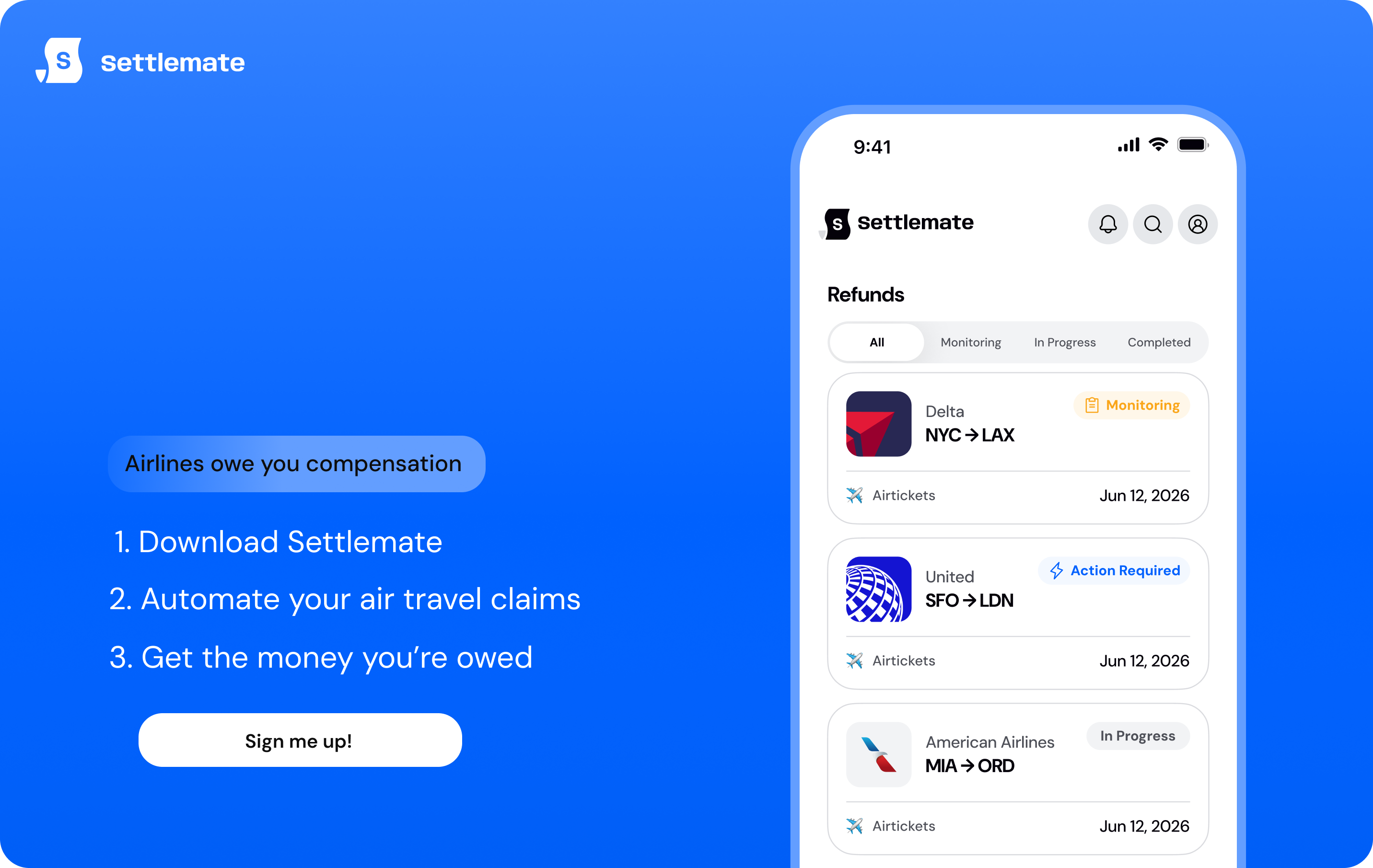
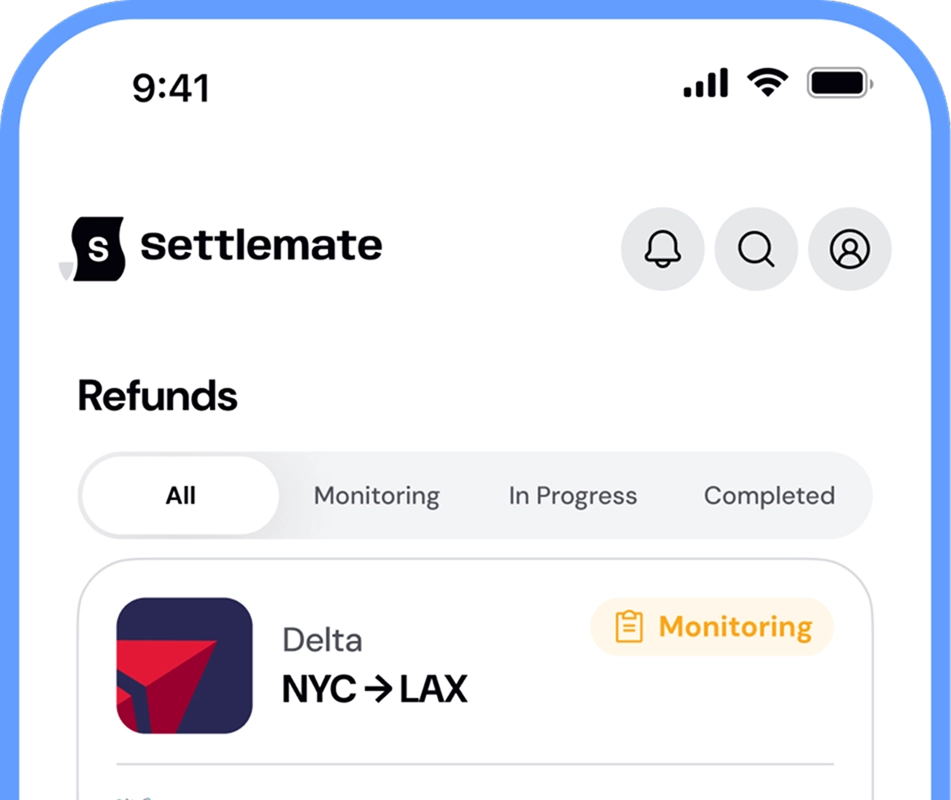
When flights are changed, delayed, or canceled, travelers rarely have the time or energy to research rules, file forms, and chase responses to recover what they’re owed. Settlemate helps identify compensation you’d otherwise miss and recovers it for you through a straightforward, automated process.
Here’s what Settlemate does with little or no involvement on your part:
- Detects delayed, canceled, overbooked, diverted, and disrupted flights directly from your inbox
- Applies the appropriate rules across EU/UK261, U.S. DIT, Montreal Convention, and airline-specific policies
- Flags compensation, refunds, hotel or meal reimbursements, and denied-boarding payouts
- Challenges voucher-only offers when cash compensation is legally required
- Tracks claims, follows up, and escalates when airlines go quiet
If you have travel insurance and credit card protections, Settlemate works alongside them. It can get you potentially hundreds of dollars in compensation and nudge you to file for reimbursement for a last-minute hotel reservation.
Here’s how it works:
- Connect your inbox with the Settlemate app
- Settlemate automatically finds your flights and monitors them
- When a disruption qualifies, Settlemate files the claim automatically
- You get paid
Download Settlemate on the App Store or Google Play and make Settlemate Retail Savings Autopilot your set-it-and-forget-it refund assistant.
Settlemate stands behind the value of your membership with a simple promise: if the verified value you receive in your first year doesn’t cover your subscription costs, we’ll extend your membership so you have more time to recover that value. Learn more about our Value Guarantee.
How different airlines handle flight disruption compensation
Not all airlines treat delayed flight compensation the same way. Some follow EU rules strictly, others rely on exclusions, and many apply different policies depending on where you’re flying and which law applies.
The table below offers flight compensation policies for major airline companies, so you can see where you stand before filing a claim: