


Your airline changed your flight, and now everything feels up in the air. Maybe the departure time has shifted, the route is different, or the flight you booked doesn’t even exist anymore. The airline's notification email is vague, customer support is slow, and you’re left wondering: Do I have to accept this? Am I owed compensation if the airline changed my flight?
Flight changes happen more often than airlines admit, and this is where many travelers accidentally give up their rights. One rushed rebooking or an overlooked cancellation can mean losing money you were legally entitled to.
In this article, you’ll learn:
- Your rights when your flight is changed
- When compensation or a refund applies
- Common mistakes to avoid
And if dealing with airlines, paperwork, and follow-ups sounds exhausting, we’ll show you how Settlemate can automatically handle flight change compensation claims on your behalf.
What are my rights if the airline changes my flight?
When an airline says your flight has been changed, it often doesn’t explain how or why. However, the type of change and the reason behind it can significantly impact your rights as a passenger.
Here are the most common types of flight changes:
- Schedule changes made before the flight
- Delayed flights
- Canceled flights
- Denied boarding
- Involuntary seat changes
- Rerouting and diverted flights
Schedule changes made before the flight
A schedule change happens when the airline modifies your departure or arrival time well before you travel. Minor adjustments might be fine, but significant shifts can disrupt your plans.
Depending on your route and the law that applies to your flight, you may be eligible for compensation or a refund:
Warning: Accepting the new schedule or alternative solutions offered by the airline can waive your rights to a refund or compensation.
Delayed flights
A delayed flight still operates, but arrives at your final destination later than planned. Delays can happen anytime and may cause:
- Missed connecting flights
- Lost hotel nights
- Car rental issues
- Missed business meetings
Unless the delay is caused by extraordinary circumstances, such as severe weather, you may be entitled to compensation. Regardless of the cause, the airline is required to provide you with care and assistance, such as meals, hotel accommodation, and transport to and from the airport.
Below are your passenger rights under different regulations in case of flight delays:
Note: A delay is measured by how late you arrive at your final destination, not how much later the plane departed. If the plane takes off later than planned, you still land on time, the arrival delay is under 2 hours, or rerouting gets you to your destination on time, there’s typically no grounds for compensation.
Cancelled flights
A cancellation means the airline has removed your flight from the schedule entirely, basically breaking the contract you agreed to. Still, your eligibility for compensation depends on:
- Notice period
- Cause of cancellation
- Applicable law
The table below shows what airlines must offer when your flight is canceled, depending on the applicable regulation:
Note: U.S. DOT doesn’t mandate payouts, but under its regulations, airlines are legally bound to follow the commitments they voluntarily publish, such as meal vouchers or rebooking, even if the law doesn’t require them to offer any of those benefits.
Denied boarding
Denied boarding happens when you have a valid ticket, arrive on time, meet all check-in and documentation requirements, and are still not allowed to board. This usually occurs because the airline oversold the flight or had to switch to a smaller aircraft.
Before it gets to that point, airlines are required to ask for volunteers to give up their seats first, usually in exchange for perks like vouchers or upgrades. Only if there aren’t enough volunteers can they deny boarding involuntarily.
If you’re denied boarding for reasons within the airline’s control (e.g., overbooking), you’re typically entitled to:
- Immediate compensation
- Rebooking on the next available flight
- Care and assistance
While the Montreal Convention doesn’t specifically spell out denied boarding rules, it does allow you to claim reimbursements for proven financial losses. Other regulations are much more specific:
Involuntary seat changes
An airline might occasionally bump you to first class, which is a clear win for you. But if you’re moved to a lower class than the one you paid for without your consent, that’s called a downgrade.
Keep in mind that downgrading isn’t the same as denied boarding. You still get to fly to your destination; you’re just not getting the level of service you paid for. Because of that, you’re usually not entitled to cash compensation, but you may be owed a refund.
Under U.S. and Canadian regulations, you’re entitled to a refund equal to the price difference between the ticket you bought and the lower-class seat you received.
In the EU and the UK, the refund is calculated as a percentage of your ticket price, based on flight distance:
- 30% for flights under 1,500 km
- 50% for flights between 1,500 km and 3,500 km (including flights between EU Member States and certain overseas territories)
- 75% for flights over 3,500 km
Rerouting and diverted flights
When something goes wrong with your flight, you’ll usually be given a few options:
- Rebooking on the next available flight
- Rerouting to your destination
- A refund if the trip no longer makes sense to you
In some cases, your flight may also be diverted. This usually happens mid-journey, when the aircraft is forced to land at an airport different from the one originally planned. Diversions can occur for several reasons:
- Bad weather
- Medical emergencies
- Air traffic control restrictions
- Technical issues
If a diversion causes a long delay, you’re usually entitled to care and assistance. And if the diversion was within the airline’s control, you may also be eligible for cash compensation.
Rerouting is often presented as a solution, but accepting a rerouted flight doesn’t automatically waive your right to compensation. If the new route gets you to your destination hours later than planned, you may still be eligible for hundreds of dollars in cash compensation under EU and Canadian rules. The eventual sum depends on the total arrival delay and whether the disruption was within the airline’s control.
Important: Rerouting is not a favor, but a legal obligation. If the airline can’t get you to your destination within a reasonable timeframe on its own flights, it may need to book you on a partner airline or even a competitor.
The hassle of submitting flight change claims manually
Even when you know you might be entitled to compensation for a changed flight, actually claiming it can often feel like more trouble than it’s worth.
First, eligibility rules can be confusing. Compensation depends on several factors, such as:
- What your route was
- How long you were delayed
- Whether the disruption was within the airline’s control
Airlines rarely spell this out, and terms like EU261, UK261, APPR, or “extraordinary circumstances” don’t exactly make things easier to understand.
If you decide to pursue flight change compensation, you need to collect a pile of documentation to build a solid claim, including:
- Boarding passes
- Receipts
- Booking confirmations
- Proof of delay
Once you finally submit your claim, airlines can take ages to respond, and when they do, it’s often a generic reply, a vague rejection, or a partial offer like vouchers or miles. Accepting those can mean giving up your right to cash compensation, even if you’re legally entitled to it.
You may end up repeating the process, resubmitting documents, and chasing customer support. It’s no surprise that many travelers just give up and leave money on the table.
Thankfully, you don’t have to deal with all this yourself. Apps like Settlemate can handle the entire claims process for you, so you get what you’re owed without jumping through hoops.
How Settlemate simplifies airline compensations
Settlemate takes the hassle out of airline compensation by doing all the work in the background, often before you even think about filing a claim. No need to decode airline policies, research regional regulations, track delays, or deal with customer support. Settlemate automates the entire process and guides you when human input is needed.
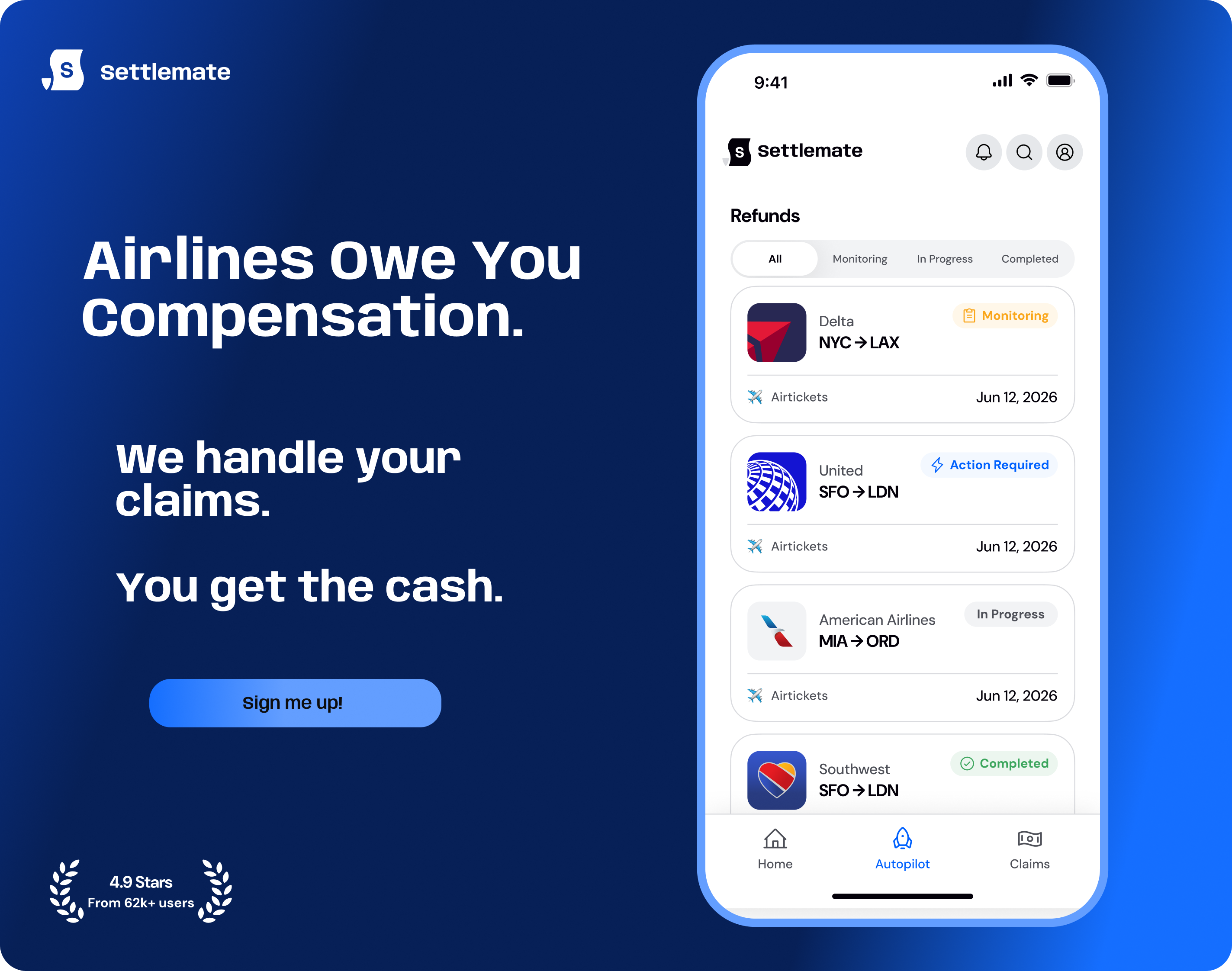
Here’s how it works:
- Connecting to your inbox: Settlemate scans your email for booking confirmations, schedule changes, and airline updates. It automatically detects disruptions like delays, cancellations, missed connections, overbookings, and seat downgrades, using both your inbox and real-time flight data.
- Checking for eligibility: When something goes wrong, Settlemate evaluates your case against the relevant laws and airline policies to determine if you qualify for compensation or reimbursement.
- Preparing and submitting the claim for you: Settlemate prepares and files your claim directly with the airline. In more complex cases, the app may ask you a few quick, targeted questions or request specific documents (e.g., a lost or delayed luggage report) to strengthen your case.
- Handling follow-ups and escalation: The app tracks airline responses, follows up when needed, and pushes back when compensation is wrongly denied, so you don’t have to deal with back-and-forth emails or delays.
- Getting your payout: When compensation or refunds are approved, money lands in your account.
Download Settlemate on the App Store or Google Play and let it handle airline compensation for you from start to finish.
At Settlemate, your membership should pay for itself, or we’ll extend it at no cost until it does. See our Value Guarantee for terms and eligibility requirements.
How airlines handle flight change compensation
When an airline changes your flight, what you’re entitled to depends on the applicable regulations as well as the airline’s published policies. Guides below explain how different airlines handle flight compensation: