

Airline strikes have become an increasingly common part of travel. In early 2026, for example, Lufthansa pilot and cabin crew strikes led to hundreds of flight cancellations, disrupting the travel plans for tens of thousands of passengers across Europe.
Many travelers don’t realize that they may be legally entitled to compensation, sometimes up to €600 per passenger, if their flight has been affected by a strike. Still, eligibility isn’t always clear-cut. Whether you qualify for airline strike compensation depends on factors such as your flight route, the regulations that apply to your journey, and who was actually on strike.
This guide breaks down your airline strike passenger rights, explaining when airlines are required to pay compensation and how to get your money hassle-free with Settlemate.
What is airline strike compensation?
Airline strike compensation is money you may be entitled to when your flight is significantly delayed or canceled because of a strike. It’s meant to make up for the disruption to your travel plans, such as:
- Missed events
- Lost time
- Missed connections
- Stress from being stranded or rerouted at the last minute
Compensation is often conflated with other forms of support that airlines provide. To claim everything you’re legally owed, you must understand the difference between:
- Compensation (cash payout): A fixed amount of money paid to you for the inconvenience caused by the delay or cancellation.
- Reimbursement of expenses: Covers reasonable out-of-pocket costs incurred because of the strike, including meals, hotel stays, transportation, and other essential expenses during the wait.
- Refunds or rebooking: If your flight is canceled or heavily delayed, you’re entitled to a full refund of your ticket or an alternative flight to your destination at no extra cost.
Important: Accepting a meal voucher or a refund doesn’t necessarily mean you’ve given up your right to compensation. Depending on the circumstances, you may be entitled to a cash payout as well as reimbursement of your expenses and a refund or replacement flight.
What are your passenger rights during airline strikes?
Your passenger rights during an airline strike depend on where you’re flying from and which airline operates your flight. Different regions apply different passenger protection rules. In many cases, you’re entitled to compensation, a refund, reimbursement of expenses, or a combination of the three.
The table below covers key legal frameworks that protect passengers and the flights they cover:
U.S. DOT rules
The DOT doesn’t require airlines to pay cash compensation for cancellations or delays caused by strikes. However, airlines must provide a full refund if your flight is canceled or significantly delayed due to a strike, and you decide not to travel. This applies even if you bought a non-refundable ticket.
The DOT also requires airlines to follow the commitments in their own customer service policies. If an airline promises compensation or travel vouchers in certain situations, it must honor that promise.
Note: Although the DOT doesn’t mandate cash compensation, it created a special rule specifically for Southwest Airlines following its 2022 holiday travel disruption. This carrier must offer at least a $75 voucher for controllable flight delays.
EU/UK Regulation 261
EU261 and UK261 provide some of the strongest passenger protections in the world. You may be eligible for cash compensation in two situations:
- Your flight is canceled fewer than 14 days before the original departure date.
- You arrive at your final destination 3+ hours later than expected.
The amount of compensation you can get depends on your flight distance:
If you arrive at your final destination less than three hours late, you may still be eligible for compensation, but the amount will be reduced by 50%.
Note: The cash payout amount is calculated per passenger, not per booking. So a family of four might receive up to €2,400 for a delayed flight due to an airline strike.
APPR rules
Under Canada’s APPR, you may be entitled to cash compensation for flight delays for reasons within an airline’s control, including many airline staff strikes.
If you arrive at your destination 3+ hours late, the amount you can claim depends on both the length of the delay and whether you're flying with a large or small airline:
Montreal Convention rules
The Montreal Convention doesn’t require airlines to pay cash compensation for delays, regardless of the reason.
Instead, it allows passengers to claim reimbursement for financial losses caused by flight delays, cancellations, or missed connections when the airline is legally liable. Depending on your circumstances, you may be able to recover the cost of:
- Meals
- Hotel accommodation
- Rebooking fees
- Transportation
- Essentials
- Missed non-refundable bookings
- Missed tours and prepaid activities
Under the Montreal Convention, the airline only has to reimburse reasonable expenses. For example, it doesn’t have to cover your dinner at a Michelin-star restaurant if another, more affordable option is available.
To support your claim, keep receipts for any expenses you incur as a result of the disruption.
What other airline strike passenger rights do you have?
Even if you’re not eligible for compensation, airlines are still obligated to support you during a disruption. When your flight is delayed or canceled due to strikes, airlines are typically required to cover essential needs while you wait. This can include:
- Meals and refreshment often provided as vouchers or reimbursement later
- Hotel accommodation if an overnight stay is necessary
- Ground transport between the airport and your hotel
- Communication, access to phone, email, etc.
These obligations are defined by EU261, the Montreal Convention, and APPR. But even where these rules don’t apply, many airlines provide similar support as part of their customer policies.
Can you claim compensation for airport strikes?
If your flight is changed or disrupted because of a strike involving airport employees or other third parties, the airline typically isn’t responsible for the disruption. Airlines don’t have to pay cash compensation for strikes outside their control.
Note that airlines often cite “extraordinary circumstances” when denying compensation claims. It’s important to know that strikes by cabin crew, pilots, and other airline employees aren’t automatically considered extraordinary circumstances and may still entitle you to compensation.
Strikes that are typically outside the airline's control include those involving:
- Air traffic control
- Border control or customs staff
- Baggage handlers
- Security staff
- External ground handling companies
How to claim airline strike compensation step-by-step
Every airline handles compensation claims differently, and the rules depend on the legal frameworks that apply to your flight. Still, the process follows the same basic steps:
- Confirm eligibility: Find out who is on strike (airline staff or airport staff) and check which regulation applies to your flight.
- Gather documents: Before submitting a claim, collect your boarding pass, booking confirmation, proof of delay or cancellation, and receipts for any expenses incurred as a result of the disruption.
- Submit your claim: Go to the airline’s website and find its compensation or customer service section. Many airlines have dedicated claim forms, which typically require your flight number, date, and route.
- Follow-up: Airlines may take a few weeks to a couple of months to respond. If you don’t hear back within a reasonable timeframe, contact the airline for an update.
If your claim is rejected or ignored, and you are confident that you’re eligible for a cash payout, you can escalate and submit a complaint to a relevant national enforcement body.
For example, those affected by the recent Lufthansa strikes can submit a formal complaint to the Luftfahrt-Bundesamt, German national civil aviation authority, if they believe their claim was wrongly denied.
How long do you have to claim airline strike compensation?
It’s always best to act as soon as possible because the longer you wait, the harder it becomes to gather documents, prove your case, and get a response from the airline.
Here are the deadlines defined by different frameworks:
Challenges of submitting airline compensation claims manually
At first glance, claiming compensation might seem as simple as filling out an online form. In reality, it can be much more complicated.
First, you have to figure out which regulations apply to your flight, how delays are calculated, and whether your situation actually qualifies. Your claim can fall apart if you arrive just under the required delay threshold or misunderstand the reason for the delay.
Then there’s the paperwork. Airlines expect precise documentation, and they don’t always make it obvious what’s needed. Missing or incomplete information is one of the easiest ways for claims to get dragged out or outright rejected.
Even if you do everything right, airlines may delay responses, deny claims with vague or no explanation, or offer less than you’re entitled to. At that point, it’s on you to push back, follow up, and potentially escalate the case.
Many passengers who are eligible for compensation never receive it because the process is confusing, time-consuming, and easy to give up on. But there’s a simpler alternative: Settlemate takes care of your claim from start to finish, handling the paperwork, follow-ups, and fine print so you don’t have to lose weeks chasing the airline.
Claim your airline strike compensation hassle-free with Settlemate
If your flight is disrupted by an airline strike, you may be entitled to up to €600 in compensation. The challenge is knowing whether you qualify and getting the airline to pay what you’re owed.
Instead of trying to navigate complicated passenger rights rules yourself and spending weeks following up with the airline, Settlemate manages the process for you from start to finish.
Here’s how it works in practice:
- Settlement detects strike-related disruptions: Once you connect your inbox, the app scans your flight confirmations and airline updates. When a strike affects your journey, it flags delays or cancellations associated with known airline strikes.
- It determines if your case qualifies: Settlement analyzes your flight against passenger rights rules and determines whether the strike involved airline staff or external factors. If you qualify, it calculates how much you could claim.
- The app prepares and submits your claim: Settlement gathers the required details and files the claim on your behalf. If anything is unclear, you may be asked a few quick, targeted questions to fill in the gaps.
- Settlement handles airline pushback: If the airline delays, rejects, or underpays your claim, the app follows up, challenges weak denials, and pushes the process forward until there’s a clear outcome.
- You get the payout: Once your claim is approved, the compensation is transferred to your account.
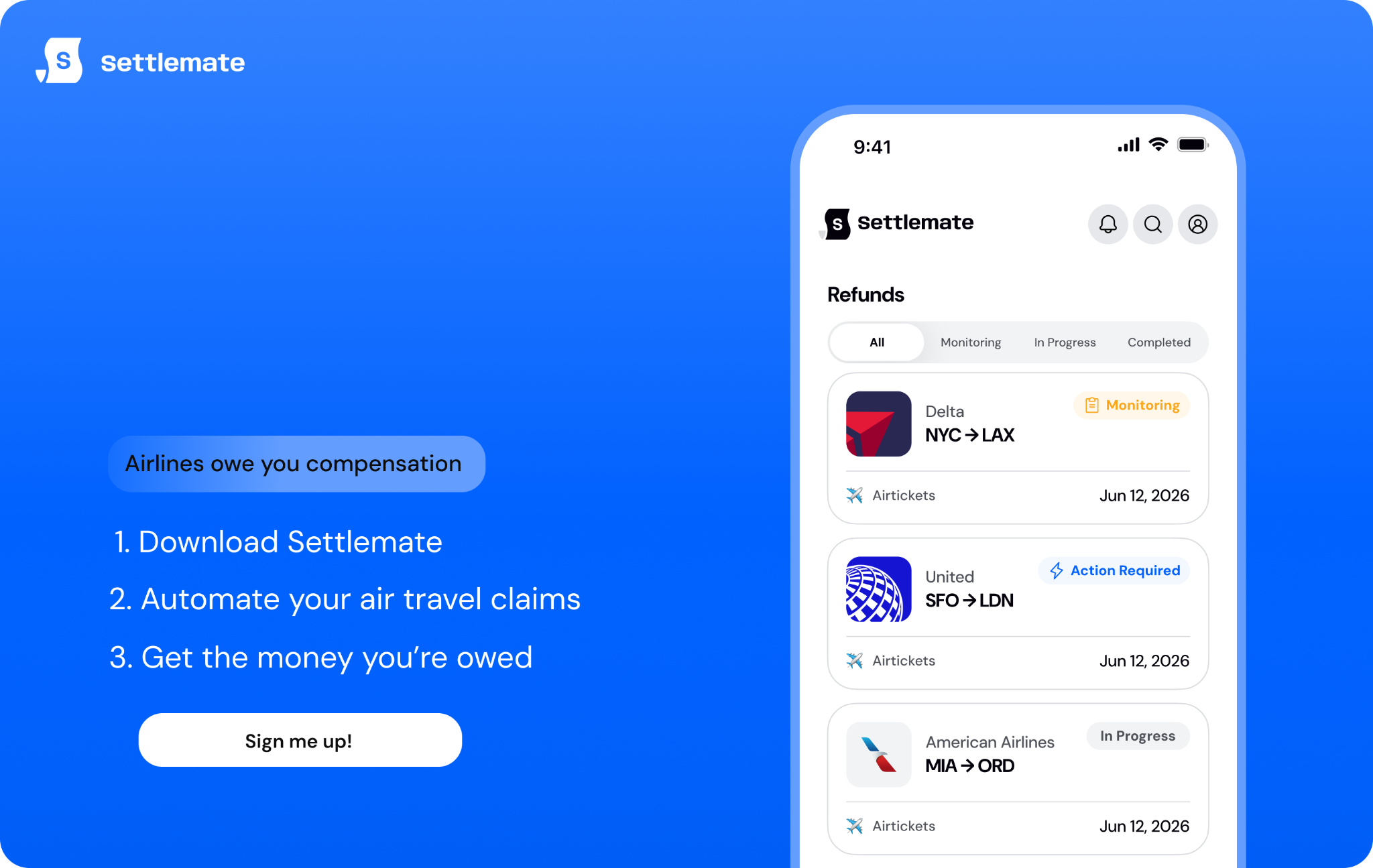
Download Settlemate from the App Store or Google Play and let it put your airline compensation claims on autopilot.
Not sure if the app’s right for you? If you don’t recover your membership fee through verified value in the first 12 months, we’ll extend your membership for another year at no additional cost. We’ll continue extending your access until the cumulative value you receive matches your original subscription fee. Learn more about our Value Guarantee.
FAQs
What happens to my ticket if an airline goes on strike?
If an airline strike disrupts your flight, you’re typically offered a choice between:
- A full refund of your ticket
- Rebooking on the next available flight with the same airline or another carrier
What happens if my flight is canceled due to an air traffic control strike?
Air traffic control strikes are considered outside the airline’s control, so you’re unlikely to receive compensation. However, you’re still entitled to a refund or rebooking. In many cases, airlines must also provide assistance during long delays, including hotel accommodation, even if compensation isn’t owed.
Is an airline strike covered by insurance?
It depends on your policy. If your plan includes trip cancellation, trip interruption, or flight delay benefits, your insurance can reimburse you for expenses caused by an airline strike.
However, travel insurance doesn’t cover foreseeable events. This means that if there had been a threat of a strike before you purchased a ticket, insurance may not cover any expenses caused by that strike.
Even if your policy helps cover your financial losses, it doesn’t replace your right to claim compensation from the airline if you’re eligible.
How different airlines handle flight disruptions
Airline policies vary when it comes to delays, cancellations, and strike-related disruptions. Explore our guides on how major carriers handle rebooking, refunds, and compensation: