Nobody wakes up thinking, “Today feels like a great day to spend an hour negotiating with my internet provider.”
Experian BillFixer (formerly known as BillFixers) and Billshark are designed to take that hassle off your hands. Both tools use professional negotiators to contact service providers and look for ways to reduce your recurring bills. But they differ in what they charge for this convenience, what bills they support, and what kind of customer experience they offer.
Our BillFixers vs. Billshark comparison breaks down these differences to help you decide which service is a better fit. We’ll also look at how both compare to a broader savings platform like Settlemate.
BillFixers vs. Billshark at a glance
Billshark is a standalone service focused exclusively on bill negotiation. BillFixers, meanwhile, has evolved into part of Experian’s broader financial-wellness platform, where bill negotiation is just one of several features. This affects how you access the service, how you pay for it, and what additional support and tools are available.
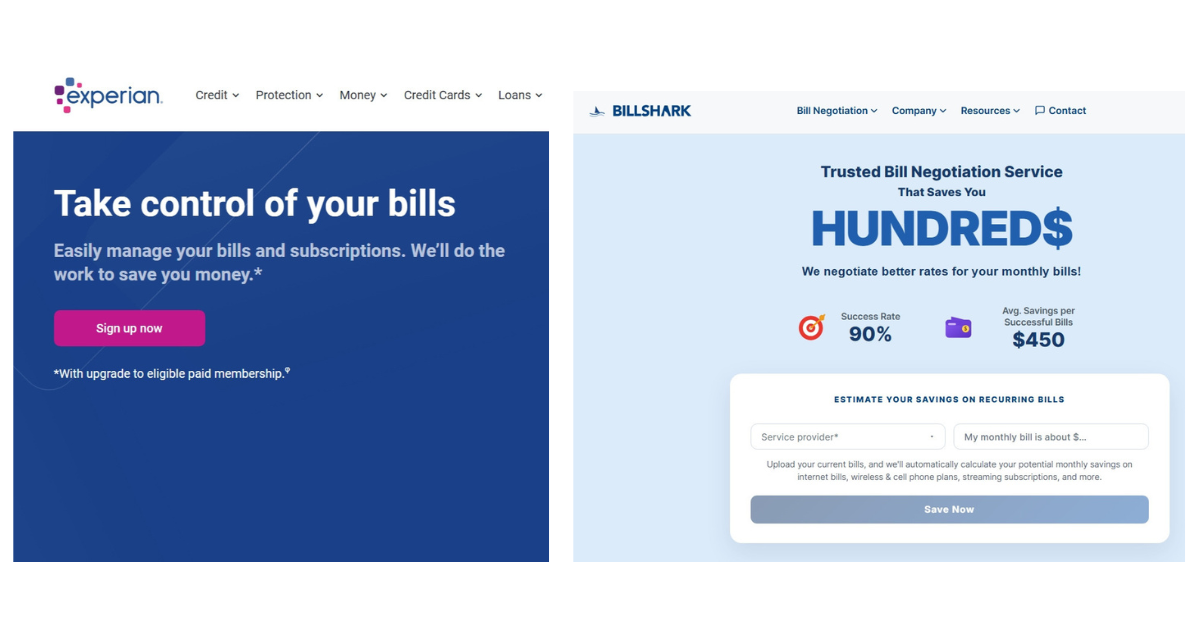
Here’s a quick overview of the main differences we’ll explore:
How do BillFixer and Billshark work?
The basic bill negotiation process is similar, but BillFixer is more closely integrated with your financial accounts, while Billshark keeps things more self-contained.
With BillFixer, you:
- Sign in to your Experian account
- Connect the bank or credit card accounts you use to pay your bills
- Find eligible recurring expenses and upload bills you want negotiated
- Give BillFixer permission to negotiate with your provider
- Receive the results, typically within three to seven business days
BillFixer’s negotiators look for promotional rates, loyalty discounts, special packages, and credits. With your permission, they can also negotiate using your name. You keep the same level of service unless you approve a change, and you can opt into AutoFix for automatic renegotiation when a promotional deal expires.
With Billshark, the process is more straightforward:
- Create an account.
- Upload the bills you want to lower.
- Provide credit card details and submit a request.
The Billshark team takes over from there. You don’t need to participate in the call, and the company says most negotiations are completed within a few business days. It sends text or email updates and says it’ll reduce your existing rate while keeping the service at the same level.
Ongoing bill monitoring and renegotiation is automatic with Billshark, so you need to opt out if you don’t want to pay for the service again.
Overall, BillFixer offers closer integration with your finances, automatically identifying recurring bills and flagging those eligible for negotiation. Billshark will only automate renegotiation for the bills you submit.
How much do BillFixer and Billshark cost?
The pricing model is the greatest difference between Billshark and BillFixer.
Billshark uses a success-fee model. There’s no upfront charge, and you pay nothing if the service fails to save you money. When it succeeds, it charges a one-time fee equal to 40% of the savings it secures. The fee is calculated over the savings period, which is capped at 24 months.
BillFixer doesn’t charge a percentage of your savings. Bill negotiation is included with eligible paid Experian memberships, and you keep 100% of any savings its negotiators secure. Two Experian plans include BillFixer:
- Money Plus: $14.99 a month
- Premium: $29.99 a month
Both plans come with a broad set of credit, financial, and identity-protection features.
BillFixer can be cheaper for someone who already wants an Experian membership, because the bill negotiation feature doesn’t take a cut of the savings. But someone who only wants help negotiating a bill may find Billshark’s pay-for-results model more straightforward because there’s no membership to maintain.
Which bills can BillFixer and Billshark negotiate?
There’s considerable overlap in the household bills covered by both services, although Billshark offers a broader range of options for businesses.
For household bills, both services cover several common recurring expenses:
- Internet
- Cellphone and wireless
- Cable
- Landline
- Home security
- Satellite TV and radio
Experian says BillFixer works with more than 40 providers across these categories. However, it currently excludes:
- Medical bills
- Insurance
- Credit card bills
- Mortgages
- Rent
- Debt services
- Legal fees
Billshark offers a separate business bill negotiation service covering:
- Mobility
- Telecom
- Waste management
- Payroll
- SaaS subscriptions
- Document services
For individuals who only want their personal and household bills lowered, there’s practically no difference between the two in terms of coverage.
Which service offers you more than just bill negotiation?
When Experian acquired BillFixers and renamed it Experian BillFixer, it became part of its broader financial ecosystem. Depending on the membership, you can also get access to:
- Credit monitoring and FICO scores
- Subscription cancellation
- Financial transaction and account monitoring
- Personal finance and spending tools
- Identity and dark-web protection
- Fraud resolution and identity theft insurance
- Experian Smart Money checking and savings products
Billshark is only focused on reducing recurring costs. Its main extra feature is BillShark Rewards, which give you Reward Dollars that can be redeemed for savings, gift cards, and prizes.
The choice comes down to whether you want bill negotiation as part of a broader financial services membership or a service focused solely on reducing expenses.
What do BillFixer and Billshark reviews say?
Since BillFixer is an Experian feature, much of the available review data relates to Experian as a whole rather than the bill negotiation feature specifically. Experian currently has a 4.2/5 TrustScore from more than 99,000 reviews on Trustpilot.
Recent reviews praise the company’s financial and credit monitoring tools, while some complaints involve:
Those ratings and comments provide context about Experian, but they shouldn’t be treated as a direct indicator of BillFixer’s negotiation success.
Billshark has a much smaller but more directly attributable review base. Its Trustpilot profile currently shows a 4.2/5 rating based on 132 reviews. Recent positive reviews commonly mention successful bill reductions and excellent customer service.
One frequent criticism, even from reviewers satisfied with the services, concerns high fees.
BillFixer vs. Billshark: Which makes more sense for you?
Both services can help lower your recurring bills. The bigger question isn’t necessarily which negotiator is better at its job; it’s how much you want bundled with the negotiation service and how you’d prefer to pay for it.
Here’s a quick way to sort that out:
Importantly, neither platform is designed to identify savings and money-recovery opportunities beyond bill negotiation.
A more comprehensive platform like Settlemate takes a broader approach, making bill negotiation just one part of a wider money-saving and recovery service rather than bundling it with general financial tools you may not need.
Settlemate: One platform for all money-recovery opportunities
Settlemate brings multiple money-saving and recovery tools together in one comprehensive platform. Rather than focusing exclusively on bill negotiation, it looks for different ways to reduce your expenses and recover money you may be entitled to.
Its Bill Negotiation feature approaches each bill type differently and seeks the most realistic ways to reduce it. For example:
- Internet and wireless: Settlemate looks for a loyalty discount, a better-fitting plan, or a fee you don’t need, and lines up a path to switching providers if better offers are available and your current provider won’t budge.
- Utilities: Since the rate is usually fixed and non-negotiable, the savings opportunities include a better plan rate, an assistance program you qualify for, or a billing error worth disputing.
- Car insurance: Settlemate compares your policy against competing quotes and checks whether your deductible is set higher than it needs to be.
Settlemate lets you decide how hands-on you want to be. There are three levels of involvement:
- Self-serve: Settlemate hands you the plan and the script, and you make the call.
- Assisted: Settlemate walks you through each step as you go.
- Concierge: Settlement takes the negotiation off your plate entirely.
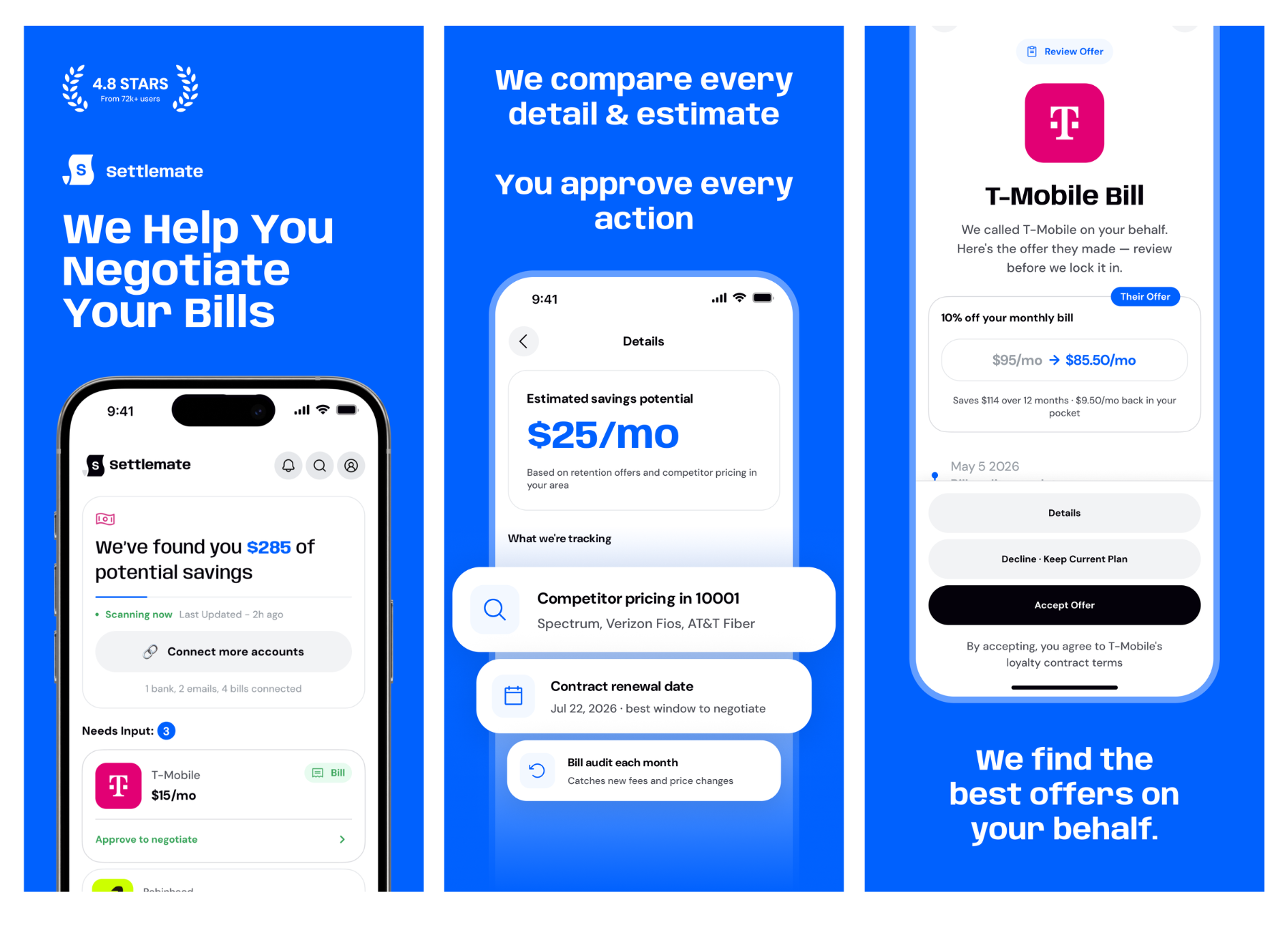
The same subscription gives you access to other money-recovery features, including:
- Late delivery compensation
- Class action settlements
- Flight disruption compensation
- Price adjustment refunds
- Subscription management
Many of these opportunities are identified automatically. Settlemate scans your inbox for receipts, booking confirmations, shipping notifications, and recurring charges that reveal potential savings or claims. That means you don’t have to remember to check whether you’re eligible for compensation after a flight disruption or whether an item you bought recently has dropped in price.
Try Settlemate for bill negotiation via web browser or by downloading the app. Start uncovering opportunities to save money and recover funds across multiple categories, all in one place.
With Settlemate, your membership should pay for itself. If the app doesn’t deliver verified value equivalent to your membership fees within the first 12 months, we'll extend your membership at no additional cost until it does. See our Value Guarantee for terms and eligibility requirements.
You may also like…
Looking beyond BillFixer and Billshark? We’ve reviewed other services that negotiate bills, manage recurring expenses, and look for additional opportunities to save, so you can compare your options in one place: