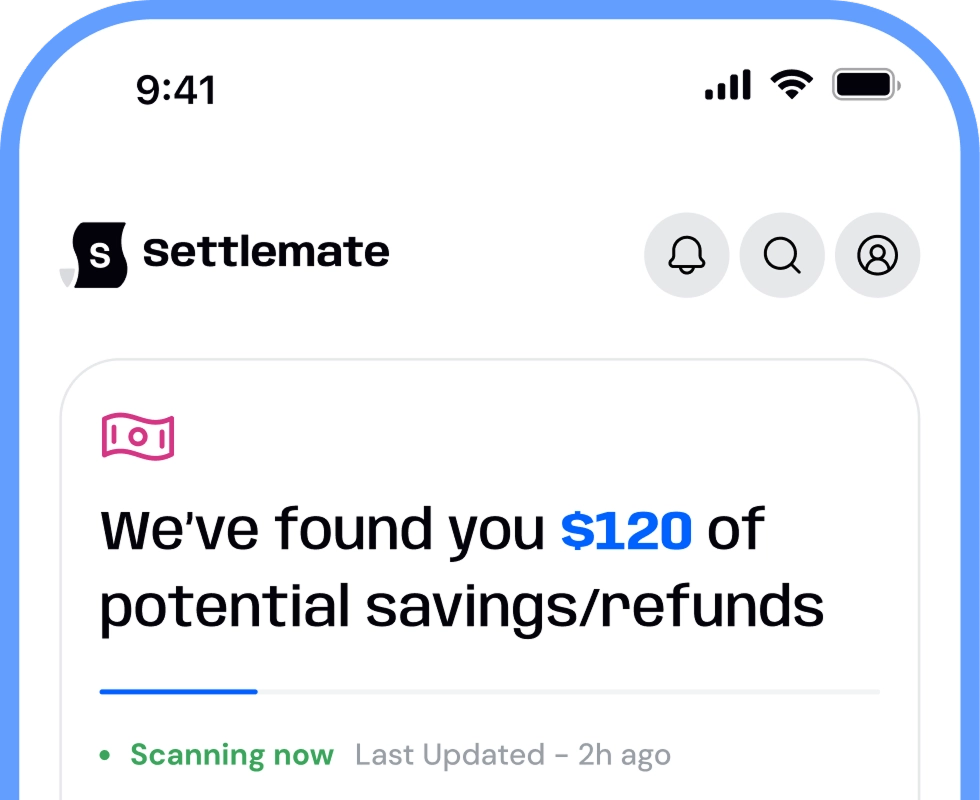



About 1 in 7 Americans has unclaimed property being held by US state treasurers. This includes forgotten bank accounts, uncashed checks, insurance payouts, and other financial assets that are turned over to the state after long periods of inactivity.
Add in more everyday examples like missed tax refunds, unpaid wages, and company refunds, and the total adds up quickly.
Fortunately, there’s no effort to hide this money.
In fact, many government agencies and consumer platforms actively work to make it easier for people to find and claim what they’re owed.
With that in mind, let’s look at 10 leading platforms that do just that and explore what the best website to find unclaimed money is, depending on your situation.
Key takeaways
- Unclaimed money is common and comes from many different sources
Millions of people are owed money for various claims, such as refunds, settlements, wages, pensions, insurance policies, and mortgages. The challenge is that these funds are spread across many agencies and databases, so they often go unnoticed. - Most official tools are legitimate but highly specific
Government-run databases are trustworthy and free to use, but each one only applies to a narrow situation, such as a tax refund, a bankruptcy case, or a terminated pension plan. - Finding unclaimed money usually requires manual effort and context
With most databases, you need to know where to look, what you are searching for, and whether you are even eligible. If you don’t suspect a specific issue, it’s easy to miss money entirely. - Deadlines matter, and missed claims can mean lost money
Several programs have time limits. Tax refunds generally expire after three years, unpaid wages can be transferred to the Treasury, and some benefits may be reduced if claimed late. - Settlemate is the easiest option for everyday consumers
While other tools focus on niche cases, Settlemate proactively finds money people are far more likely to be owed, such as class action settlements, product recalls, airline refunds, and data breach payouts.
What is the best website to find unclaimed money? An overview of the top 10 choices
1. Settlemate
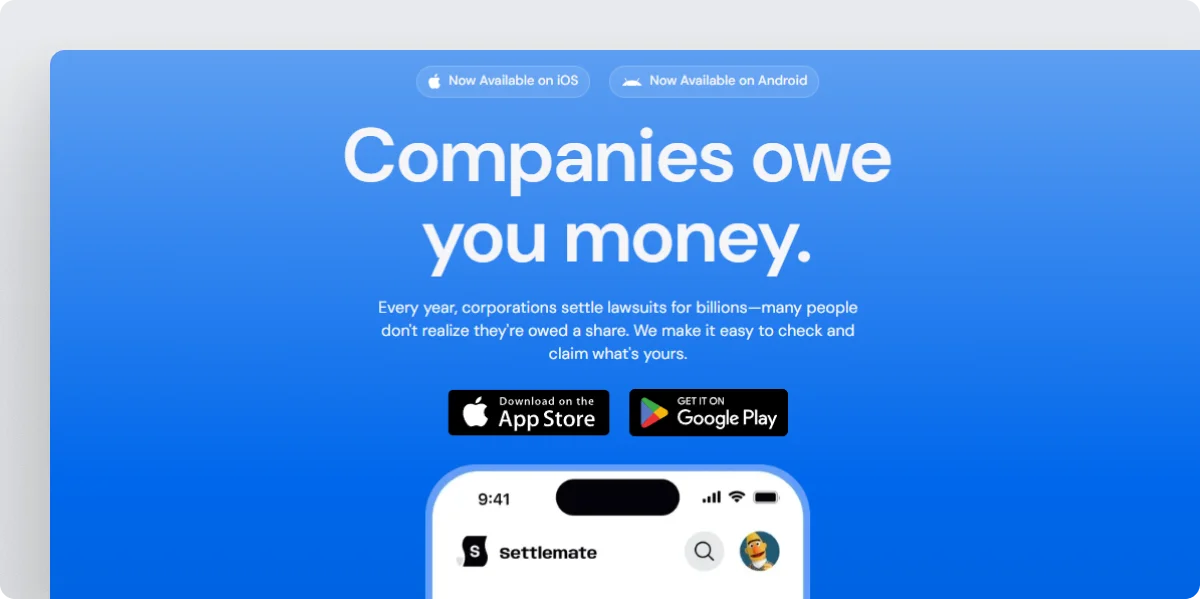
Settlemate is a consumer fintech platform that helps users find and claim money they’re legally owed from class action settlements, product recalls, and similar refund opportunities.
Settlemate is primarily a mobile app, but it also has a web app accessible via desktop, which is why it earns its place at the top by addressing the biggest gap in unclaimed money: Most people never know they’re eligible to claim it.
Types of unclaimed money you can find
Settlemate focuses on overlooked but legitimate payouts, including:
- Class action settlement payments
- Product recall refunds
- Price-drop and post-purchase refunds
- Other consumer compensation claims
How the search process works
Instead of manual searching, Settlemate automates discovery. All you need to do is:
- Sign up for the app.
- Answer a few questions.
- Connect your email (optional).
From there, Settlemate:
- Scans for eligible claims automatically
- Alerts you when new settlements or refunds apply to you
- Autofills and submits claim forms on your behalf
- Tracks claim status and payout progress in real time
Who should use this website
Settlemate is best for consumers who don’t actively track class action settlements or refund opportunities and often miss deadlines simply because they’re unaware they qualify.
It’s especially useful for people who want a hands-off way to capture “found money” without monitoring legal notices, filling out forms, or keeping track of claim timelines themselves.
2. Unclaimed.org (NAUPA)
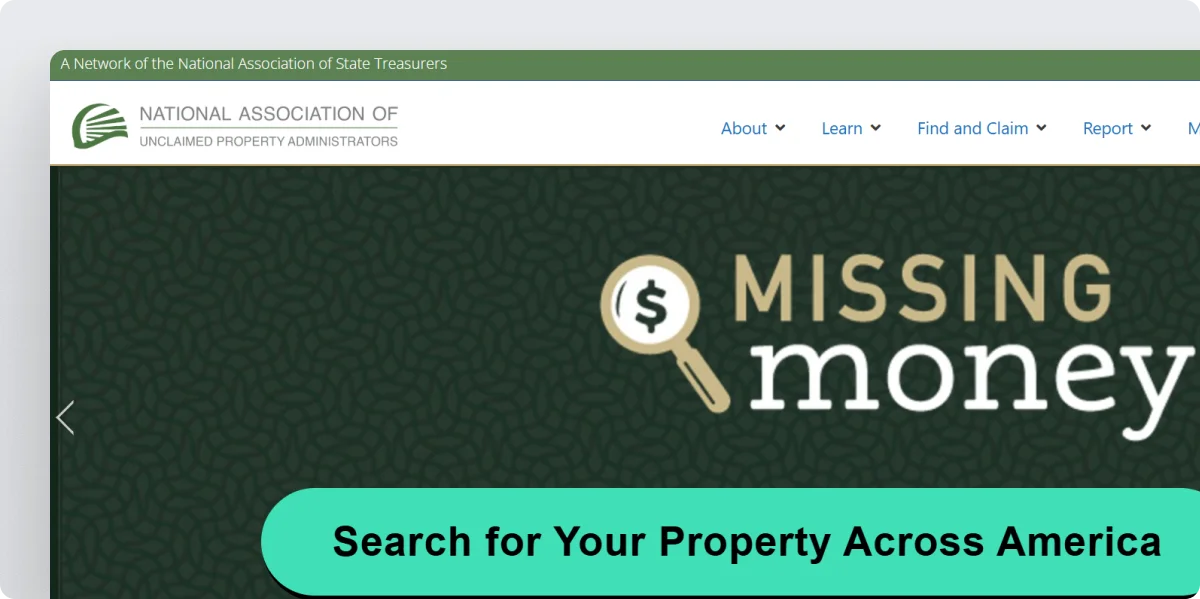
Unclaimed.org is the official hub run by the National Association of Unclaimed Property Administrators (NAUPA), an affiliate of the National Association of State Treasurers.
NAUPA represents unclaimed property programs from all 50 US states, Washington, D.C., Puerto Rico, and several international jurisdictions.
The website directs users to official state programs that collectively return over $5 billion to rightful owners each year.
Types of unclaimed money you can find
Unclaimed.org covers nearly all forms of state-held unclaimed property, including:
- Checking and savings accounts
- Uncashed payroll checks and refunds
- Stocks, dividends, and CDs
- Insurance payouts and annuities
- Utility deposits and customer overpayments
- Safe deposit box contents
How the search process works
Unclaimed.org acts as a central starting point. Here’s how to use it to find unclaimed property:
- Visit the home page and scroll to the interactive map.
- Select your state(s) on the map.
- Search official state databases.
- Follow the on-screen instructions to submit a claim directly through the state website.
Who should use this website
Anyone in the US who wants a free, authoritative starting point to search multiple states for officially held unclaimed property will benefit from using unclaimed.org.
3. Where’s My Refund?
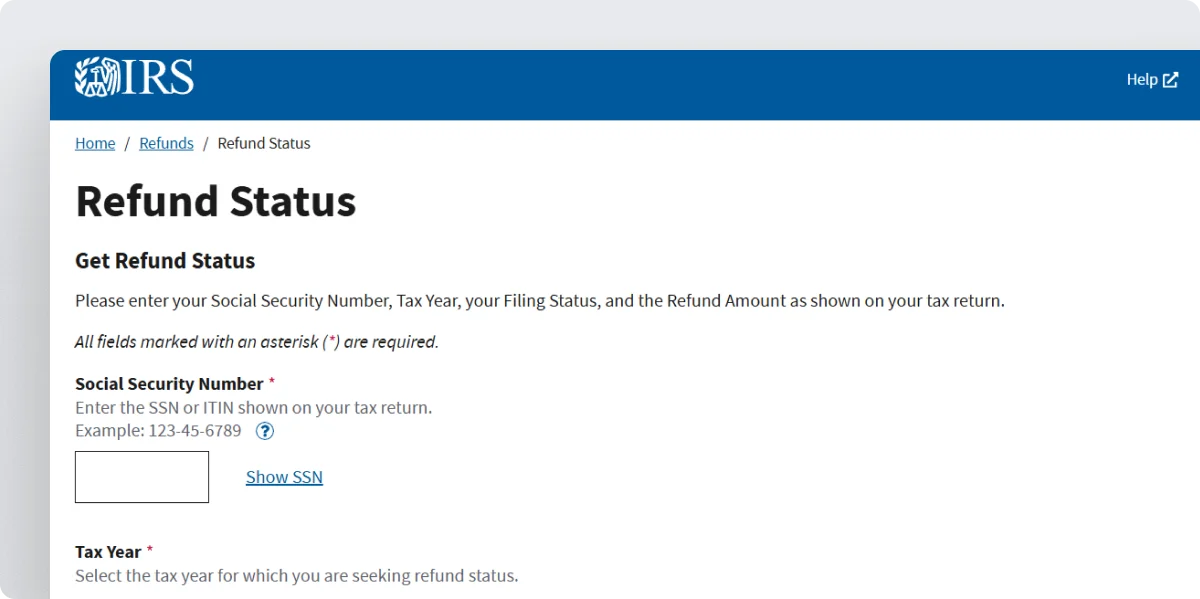
Where’s My Refund? is the official tool from the Internal Revenue Service (IRS) for tracking federal tax refunds, including refund checks that may have been missed, delayed, or never received.
It’s operated directly by the US government and is the most authoritative way to check the status of current-year and recent past-year tax refunds.
Taxpayers generally have three years to claim a federal tax refund, after which the money is forfeited.
Types of unclaimed money you can find
This tool focuses specifically on federal tax refunds, including:
- Missed or delayed IRS refund checks
- Refunds from e-filed or paper tax returns
- Refunds tied to refundable credits
How the search process works
Checking your refund status is straightforward:
- Enter your Social Security number or Individual Taxpayer Identification Number (ITIN).
- Choose the tax year.
- Select your filing status.
- Enter the exact refund amount shown on your tax return.
- Click on “Submit.”
Who should use this website
This website is well-suited for US taxpayers who believe they missed a federal tax refund, experienced a delay, or want to verify the status of a recent or amended tax return directly with the IRS.
4. US Courts Unclaimed Funds Locator
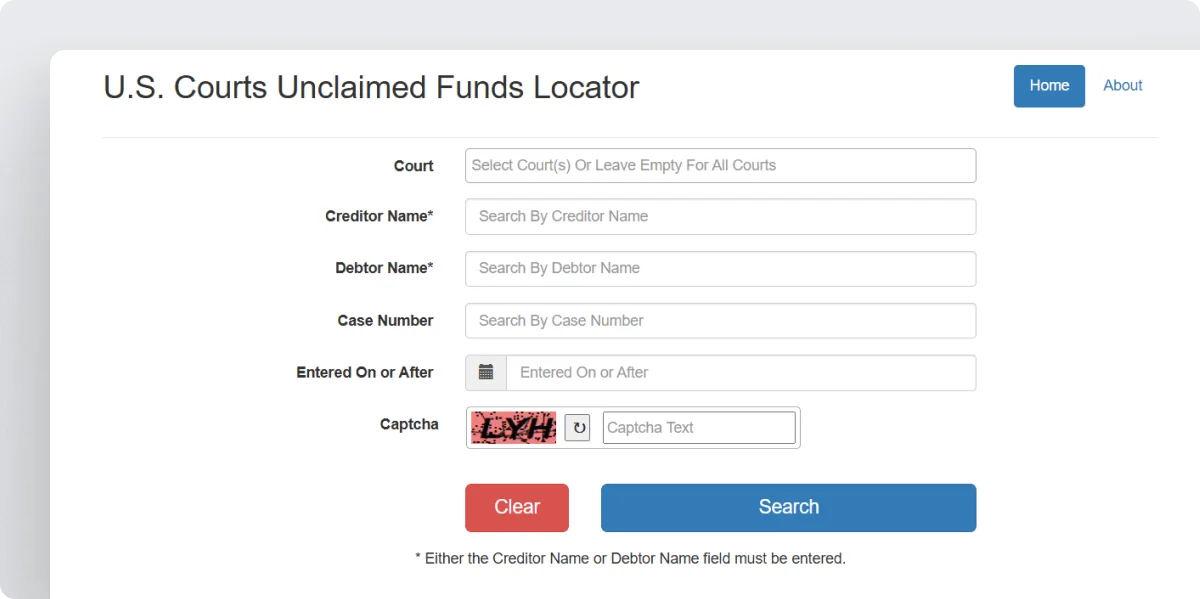
The US Courts Unclaimed Funds Locator is an official government tool you can use to search for money held by federal bankruptcy courts.
When a person or business declares bankruptcy, funds may be set aside for creditors. If those funds aren’t claimed—often due to address changes, missed notices, or dissolved businesses—they’re held by the court and can be claimed later by the rightful owner.
Types of unclaimed money you can find
This database is limited but highly specific, covering:
- Bankruptcy distributions owed to creditors
- Unclaimed dividends from bankruptcy cases
- Funds belonging to individuals or businesses listed in court filings
How the search process works
The search is manual but straightforward:
- Select the bankruptcy court.
- Enter a creditor name or debtor name.
- Review matching cases.
- Contact the listed court to file a claim.
Who should use this website
This tool is intended for individuals, heirs, or businesses that were listed as creditors in a federal bankruptcy case and want to check whether the money owed to them is still being held by a US bankruptcy court.
5. NCUA Unclaimed Deposits
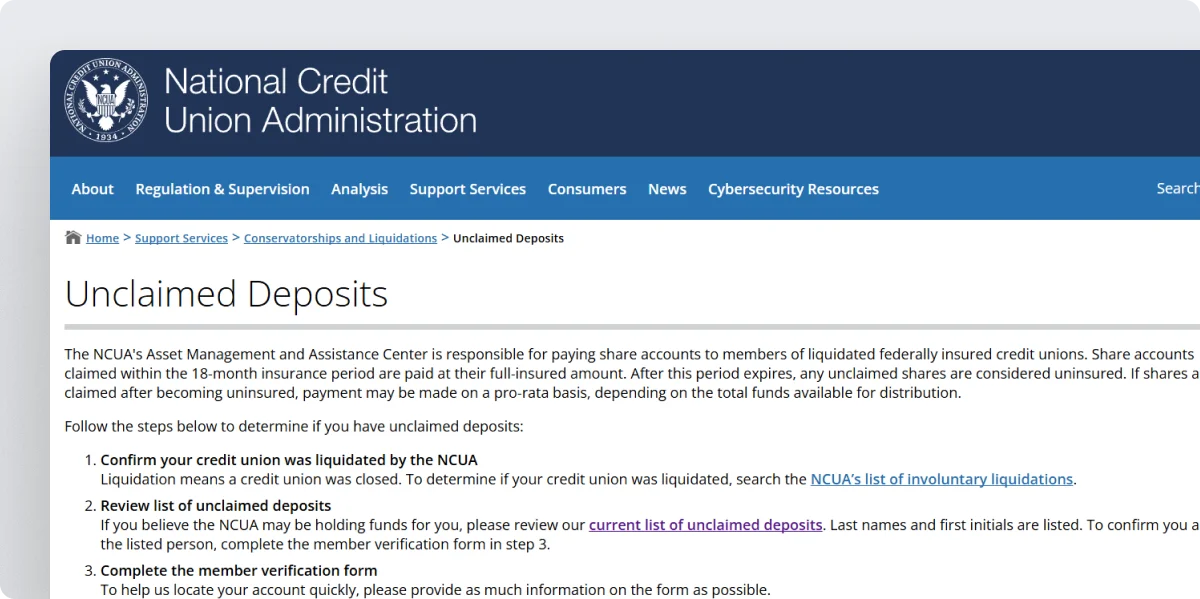
National Credit Union Administration (NCUA) Unclaimed Deposits is an official government resource for finding money left behind in federally insured credit union accounts that were closed and liquidated.
It’s operated by the NCUA’s Asset Management and Assistance Center, which is responsible for returning share deposits to members when a credit union fails.
Funds claimed within the insurance period are typically paid in full, while older claims may be paid on a pro-rata basis.
Types of unclaimed money you can find
This tool focuses specifically on credit union funds, including:
- Unclaimed share (savings) accounts
- Deposits from liquidated federally insured credit unions
How the search process works
Follow these simple steps to claim your money:
- Confirm the credit union was liquidated by the NCUA.
- Review the NCUA’s published list of unclaimed deposits.
- Complete and submit a member verification form.
Who should use this website
This resource is intended for former credit union members or their heirs who believe they may have unclaimed deposits from a federally insured credit union that was liquidated by the NCUA and never fully paid out.
6. Department of Labor Unpaid Wages Database
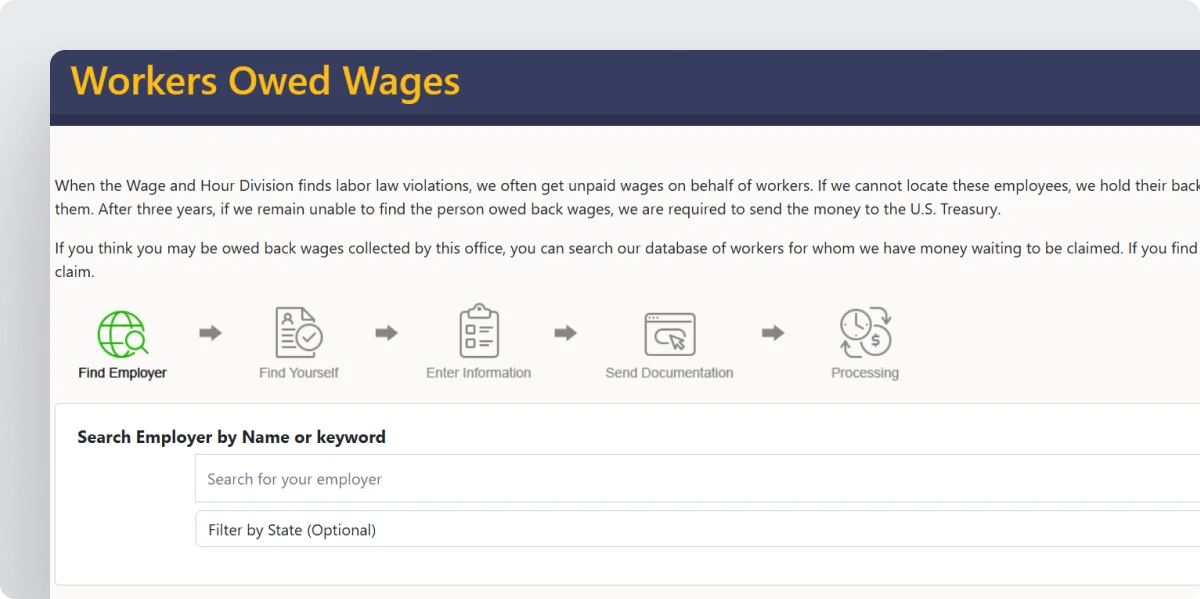
The US Department of Labor operates an official database that helps workers recover unpaid wages collected after labor law violations.
When the Wage and Hour Division secures back wages but can’t locate the affected employees, the money is held temporarily so workers can claim it.
If unclaimed after three years, the funds are transferred to the US Treasury.
Types of unclaimed money you can find
This database focuses specifically on:
- Unpaid back wages recovered by the Wage and Hour Division
- Wages owed due to minimum wage or overtime violations
How the search process works
The process is simple and free:
- Search by employer name or keyword.
- Filter results by state.
- Review the listings to see if wages are owed.
- Submit a claim if your name appears.
Who should use this website
This tool is designed for employees or former employees who suspect the Department of Labor may be holding their unpaid wages that were never delivered.
7. Pension Benefit Guaranty Corporation (PBGC) Unclaimed Retirement Benefits
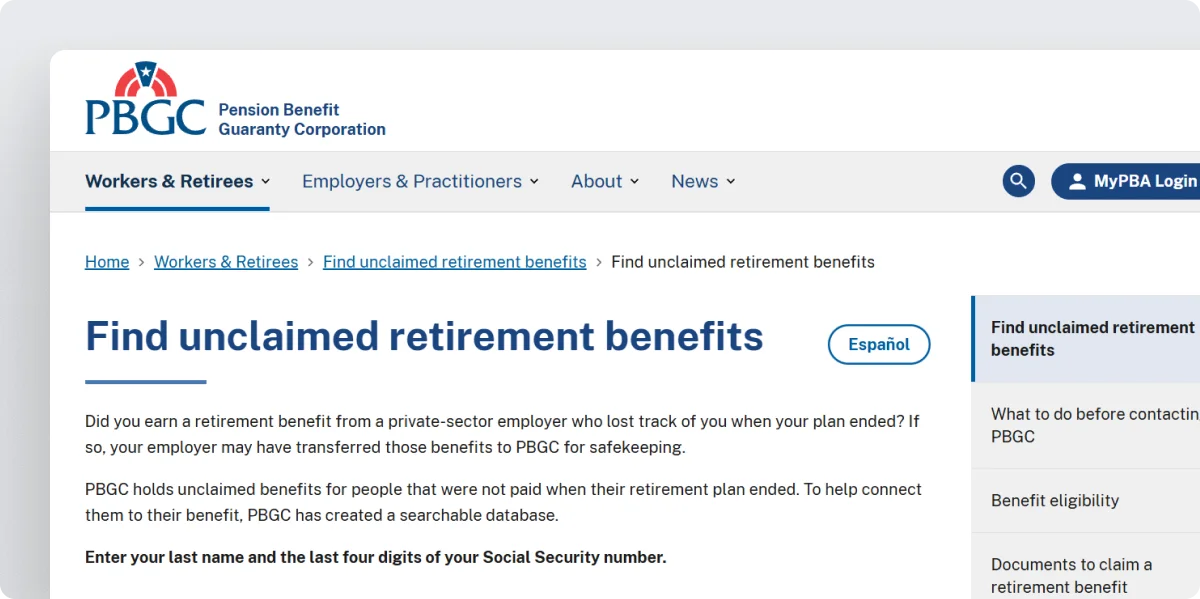
The Pension Benefit Guaranty Corporation (PBGC) is a US government agency that safeguards retirement benefits when private-sector pension plans end or employers can no longer meet their obligations.
If a company loses track of former employees after a plan terminates, unclaimed benefits may be transferred to PBGC for safekeeping until the rightful owners come forward.
The PBGC maintains an official, searchable database to help reconnect people with these retirement funds.
Types of unclaimed money you can find
The PBGC database includes:
- Unclaimed pension benefits from terminated private-sector plans
- Retirement benefits owed to former employees, beneficiaries, or alternate payees
How the search process works
Here’s how to claim your retirement funds quickly and securely:
- Enter your last name.
- Provide the last four digits of your Social Security number.
- Review any matching benefit records.
- Follow PBGC instructions to claim your benefits.
Who should use this website
This website is targeted at current or former private-sector employees, beneficiaries, or heirs who believe they have unclaimed pension benefits from an employer that lost contact with them after a retirement plan ended.
8. US Department of Veterans Affairs (VA) Unclaimed Insurance Funds
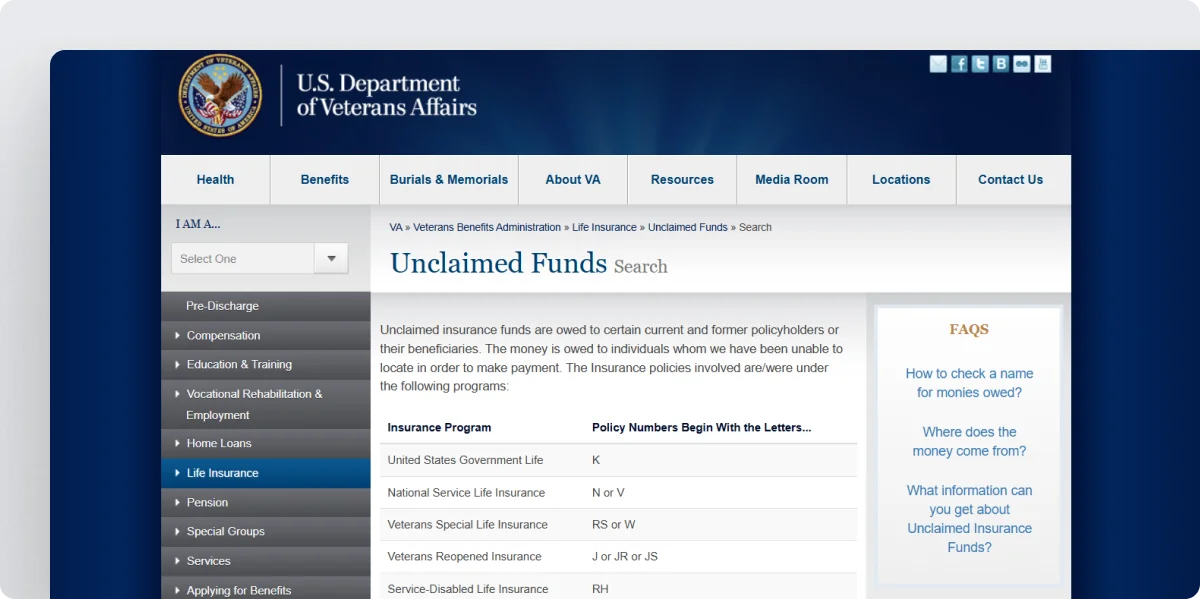
The US Department of Veterans Affairs maintains an official database for unclaimed insurance funds owed to certain veterans, former service members, or their beneficiaries.
These funds exist because the VA was unable to locate the rightful recipient of the payment.
The database applies only to specific VA-run life insurance programs and doesn’t include Servicemembers’ Group Life Insurance (SGLI) or Veterans’ Group Life Insurance (VGLI).
Types of unclaimed money you can find
This database includes unpaid proceeds from older VA insurance policies, such as:
- United States Government Life Insurance
- National Service Life Insurance
- Veterans Special Life Insurance
- Veterans Reopened Insurance
- Service-Disabled Life Insurance
How the search process works
The search is simple and name-based:
- Enter the veteran’s last name (first name optional).
- Review any matching insurance records.
- Follow VA instructions to submit a claim if funds are listed.
Who should use this website
This search is useful for veterans or family members who suspect that benefits from a VA-managed life insurance policy were issued but never reached the intended recipient.
9. HUD/FHA Mortgage Insurance Refund Database
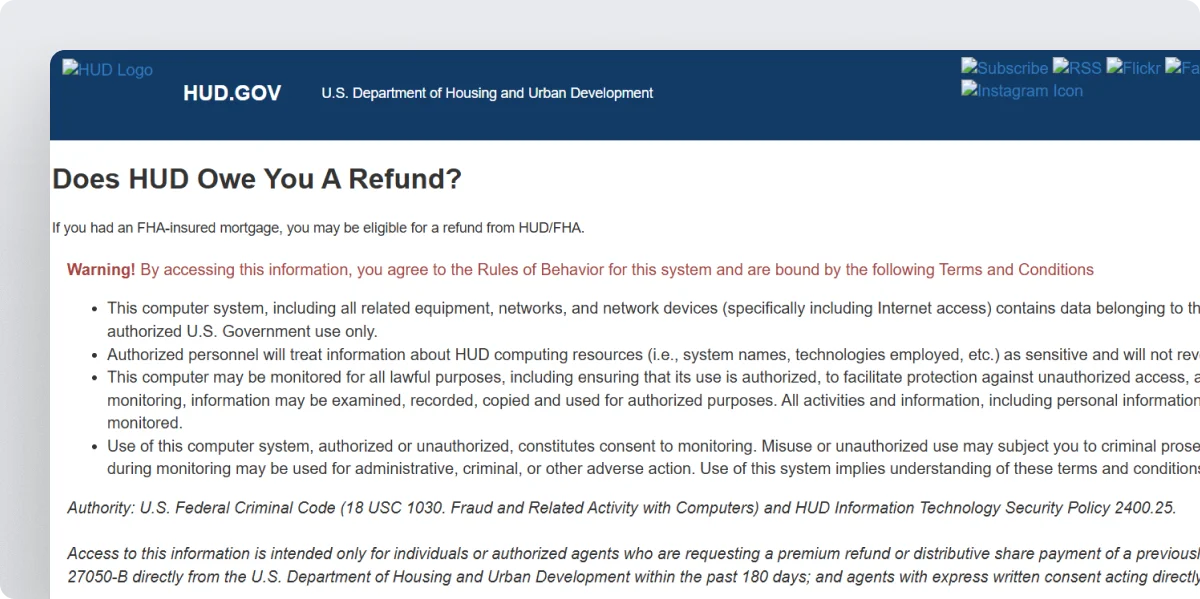
The US Department of Housing and Urban Development (HUD) operates an official database to help former homeowners recover unclaimed refunds tied to FHA-insured mortgages.
These refunds—often called mortgage insurance premium refunds or distributive share payments—may be owed when borrowers paid more into an FHA insurance program than was ultimately required.
Funds remain unclaimed when HUD is unable to locate the eligible homeowner.
Types of unclaimed money you can find
This database is limited to FHA-related housing refunds, including:
- FHA mortgage insurance premium refunds
- Distributive share payments from FHA-insured loans
How the search process works
The search can be completed in a few steps:
- Enter your last name or FHA case number.
- Optionally add the property city and state.
- Review any matching refund records.
- Contact HUD to request payment if your name appears.
Who should use this website
This website is intended for former homeowners who had an FHA-insured mortgage and want to check whether HUD is holding an unclaimed insurance refund or distributive share payment in their name.
10. SEC Distributions to Harmed Investors Database
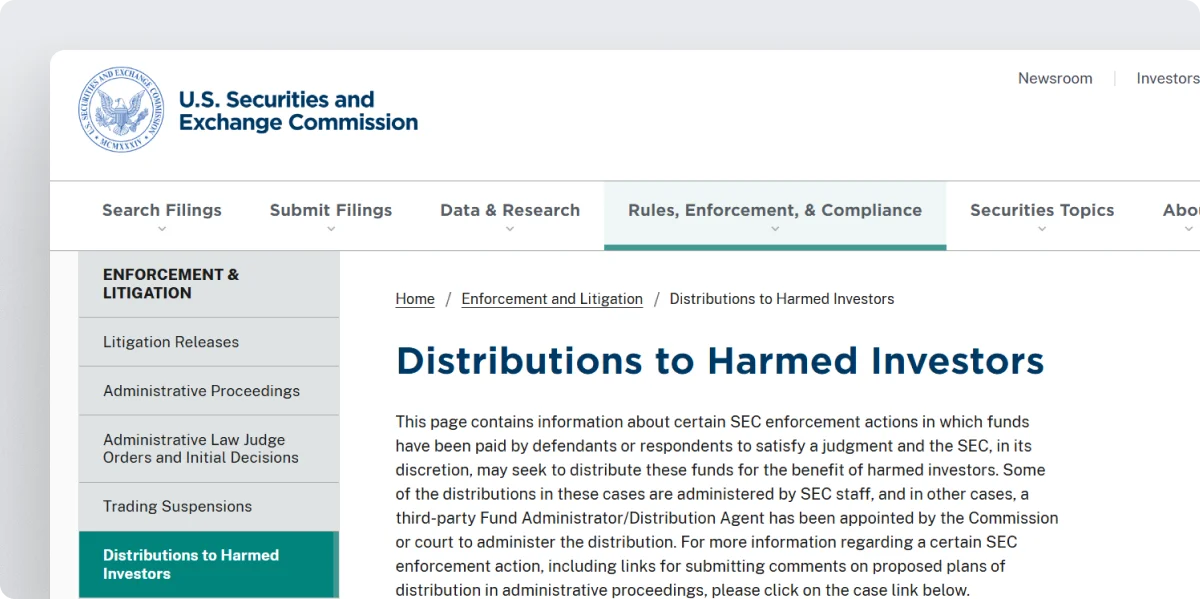
When enforcement actions result in financial recoveries, the US Securities and Exchange Commission may establish investor distribution plans to return money to those who were harmed.
This database serves as a centralized place to track those cases and understand how and when payouts occur.
Types of unclaimed money you can find
The unclaimed money in this database mainly refers to investment-related recoveries, including:
- Distributions from SEC enforcement actions
- Fair Fund payments and disgorgement proceeds
- Investor compensation tied to fraud or misconduct cases
How the search process works
The process is case-driven rather than name-based:
- Search or browse SEC enforcement cases.
- Review distribution details for relevant cases.
- Follow the listed instructions to file a claim or check eligibility.
Who should use this website
Investors can use this database to determine whether money recovered in an SEC case is available to individuals impacted by a particular company or investment.
The easiest way to find unclaimed money in 2026
There’s a surprising amount of unclaimed money out there; you just need to know where to look.
And while it’s difficult to say what the best website to find unclaimed money is, since most tools are designed for very specific situations, one option clearly stands out for everyday consumers: Settlemate.
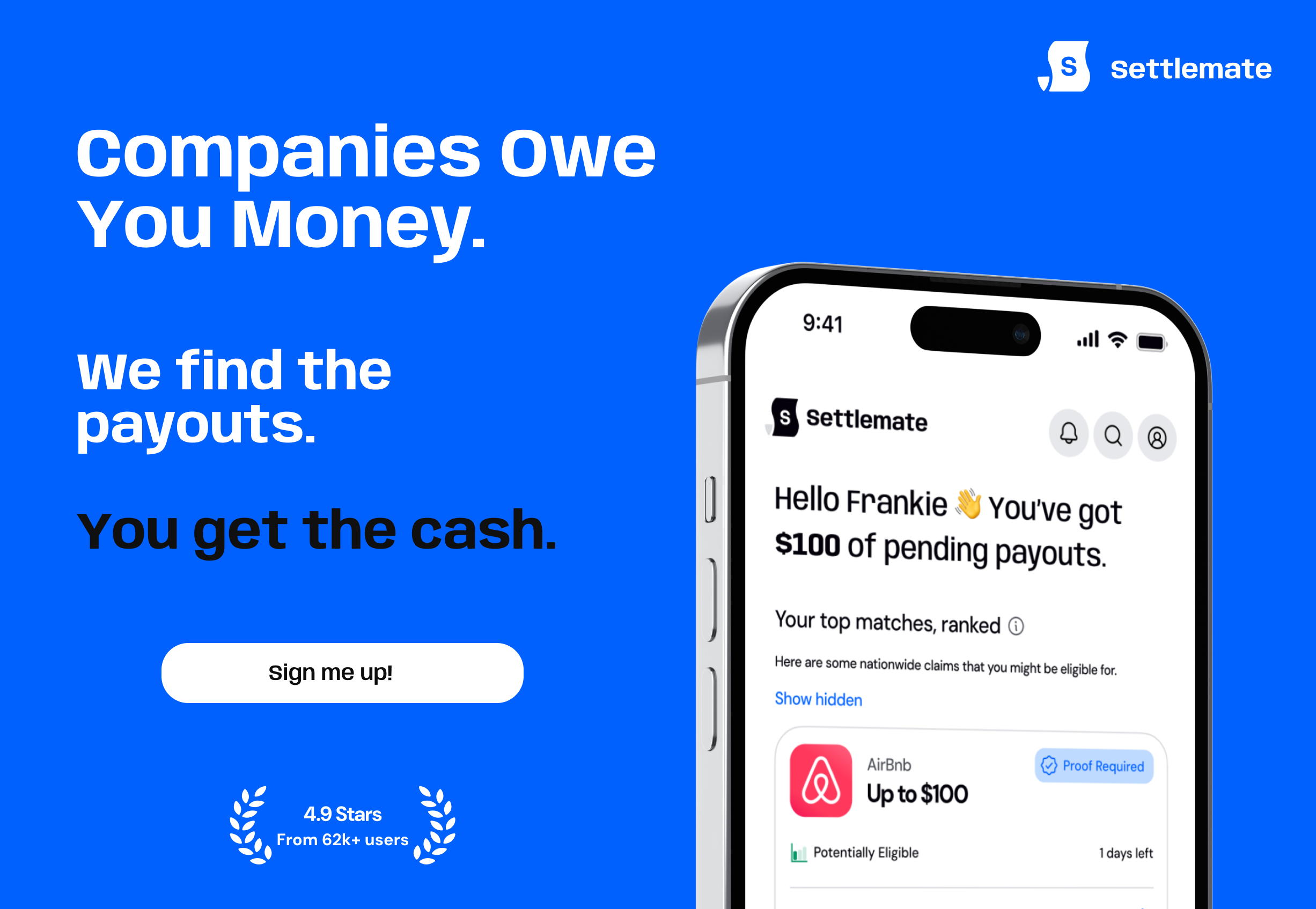
Most of the resources on this list focus on narrow categories, like bankruptcy cases, old pension plans, FHA mortgage refunds, or unpaid wages from a specific employer.
Settlemate takes a different approach by proactively finding money people are far more likely to be owed, such as food recalls, airline refunds, price adjustments, and the all-too-common class action settlements tied to data breaches.
Instead of searching databases one by one, Settlemate does the work for you.
If you want a modern, low-effort way to uncover unclaimed money in 2026, download the Settlemate app on the App Store or Google Play, and let it start finding what you’re owed automatically.