

.png)
The controversy over Discover’s misclassified credit cards and the extra fees charged to customers eventually sparked a major class action lawsuit and led to a substantial settlement. If you’re among the affected, this is your chance to recover the money that was unfairly taken away from you.
However, to claim your share of the settlement, you must submit a claim before the final filing deadline and provide solid documentation, which leaves little room for error.
In this guide, we’ll tell you everything you need to know about the Discover interchange fees class action settlement: who qualifies, how to file a claim, and what kind of payout you can expect.
We’ll also show you how Settlemate can simplify the entire process by helping you automate and manage your class action claims effortlessly.
What is the Discover class action lawsuit about?
The class action lawsuit involving Discover Financial Services stems from allegations that its subsidiary, Discover Bank, misclassified certain consumer credit cards as commercial cards during transactions. Since commercial cards carry higher interchange fees (the fees merchants pay every time they accept a card), merchants were charged more than they should have been for transactions that were actually standard consumer card purchases.
According to the complaint, this misclassification went on for roughly 17 years, from 2007 to 2023, and affected over five million consumer credit cards. The issue was allegedly internal and systematic, leaving merchants with no reliable way of telling whether a transaction was processed as a consumer or commercial card at the time of sale.
Discover hasn’t admitted any wrongdoing, but it has agreed to a settlement to resolve the allegations and avoid a lengthy legal battle. The settlement fund is valued at staggering $1.225 billion.
To help put everything into perspective, here’s the lawsuit’s key timeline:
Good to know: Consumer credit cards are standard personal cards, with a typical interchange rate of 1.4% per transaction. Meanwhile, commercial credit cards include business and rewards cards, which carry an interchange fee of 2.4% per transaction. That difference is what drove up merchants’ processing costs and ultimately led to the class action lawsuit.
Who qualifies for the Discover credit card interchange fees settlement
You may qualify for the Discover interchange fees settlement if you processed or accepted a misclassified Discover credit card transaction anytime between January 1, 2007, and December 31, 2023.
The settlement class includes three main groups:
- End merchants: Individuals or businesses that directly accepted Discover credit cards from customers. If someone paid you with a Discover card during the class period, you likely fall into this group.
- Merchant acquirers: Companies that have formal agreements with Discover to facilitate Discover card transactions. If your business enables merchants to process card payments, this may be your category.
- Payment intermediaries: Businesses that handle Discover transactions for other companies but aren’t considered end merchants or merchant acquirers. If you serve as an intermediary in the transaction chain, you probably fit here.
If you received an official settlement notice, Discover’s records already show that you’re part of the class, and the notice should indicate which category you belong to. But even if you didn’t get a notice, you can still file a claim if you believe you qualify.
What you can get from the Discover settlement
The settlement guarantees that at least $540 million will be distributed to class members after legal fees and administrative costs, with the total payout potentially reaching up to $1.225 billion. Because the amount each merchant was overcharged varies, individual payouts won’t be the same for everyone.
Your compensation will be calculated based on several factors:
Every approved claimant is guaranteed at least $10, even if their calculated overcharge amount is small.
Quick note: A pro-rata distribution means that the settlement fund is divided based on each claimant’s proportional share of the total estimated overcharges.
How to file a claim: Step-by-step
You can file your claim either online, which is the quickest and easiest option, or by mail. Whatever method you choose, make sure you submit all required documents before the final filing deadline of May 18, 2026.
Here’s how to file your claim:
- Confirm your eligibility: Make sure your business accepted or processed Discover card transactions during the eligible period.
- Gather your records: This may include merchant statements, transaction data, financial reports, or any other documentation that shows Discover card activity.
- Go to the settlement website: You’ll find the claim form in the Documents section.
- Fill out the claim form: Provide the requested details and upload your supporting documents.
- Submit your claim:
- Online: Upload your document directly through the website.
- By mail: If you take the mail route, print out the claim form, complete it, and send it to the following address:
Discover Card Merchant Settlement Payment Intermediary Status
PO Box 2497
Portland
OR 97208-2497
Important: Keep in mind that once you file your claim, you can’t withdraw it. You can only request to opt out before filing.
What happens after you file
After the claim period closes, the settlement administrator will first review all submitted claims to verify eligibility. Then, they’ll calculate each claimant’s estimated overcharges to determine their share of the settlement fund.
Payments will be issued either by check or electronic transfer, depending on the option you select when filing your claim. While there’s no exact payout date yet, payments are expected to start sometime after the final approval hearing on May 20, 2026.
Common challenges with filing class action settlement claims manually
Class action settlements can be a great opportunity to recover losses, but many people either never file their claims or submit them incorrectly and end up missing out on money they’re owed. Going through the claims process on your own comes with a few hurdles, including:
- Uncertainty about required documentation: It’s not always clear what proof you need to provide. Some people give up rather than spend hours hunting down documents that might not be the right ones.
- Errors in claim forms: Claim forms often ask for lots of details, and it’s surprisingly easy to enter something incorrectly. A small mistake can jeopardize your entire payout.
- Strict timelines: Miss the filing deadline, and your chance at compensation is gone. Even if you intend to file, a busy schedule can make it all too easy to postpone the task until it’s too late.
If you want to make sure that you get the money you’re entitled to, consider automating class action claims with Settlemate.
How can Settlemate simplify filing class action claims
Filing a class action claim can feel like a maze: deadlines here, documents there, and a whole lot of fine print in between. That’s the point where most people give up. Settlemate steps in before that happens. The app cuts through all the confusion, handles the heavy lifting, and makes it easier than ever to claim the money you’re owed.
Most importantly, Settlemate doesn’t stop at the Discover credit card settlement. It keeps an eye on every eligible class action and guides you through each filing, so you never miss an opportunity to get paid.
Here are some of its key features:
- Automatic detection: With your permission, Settlemate securely scans your emails and purchase history to identify settlements you qualify for. It also keeps watch on active class action databases, so you don’t have to spend time searching for new cases.
- Effortless filing: Whenever possible, Settlemate pre-fills your claim forms using the info already linked to your account. That means no typing everything out by hand and far fewer chances of making a mistake.
- Clear proof guidance: If a claim requires proof, Settlemate breaks it down for you. You’ll know exactly what you need, where to find it, and how to upload it without guesswork.
- Real-time alerts: You’ll get instant notifications about new settlements or important updates to the existing ones. Plus, you can track the status of all your claims in one simple dashboard.
- Payout estimates: Before you file, Settlemate will show you potential payout ranges so you can quickly decide whether a claim is worth pursuing.
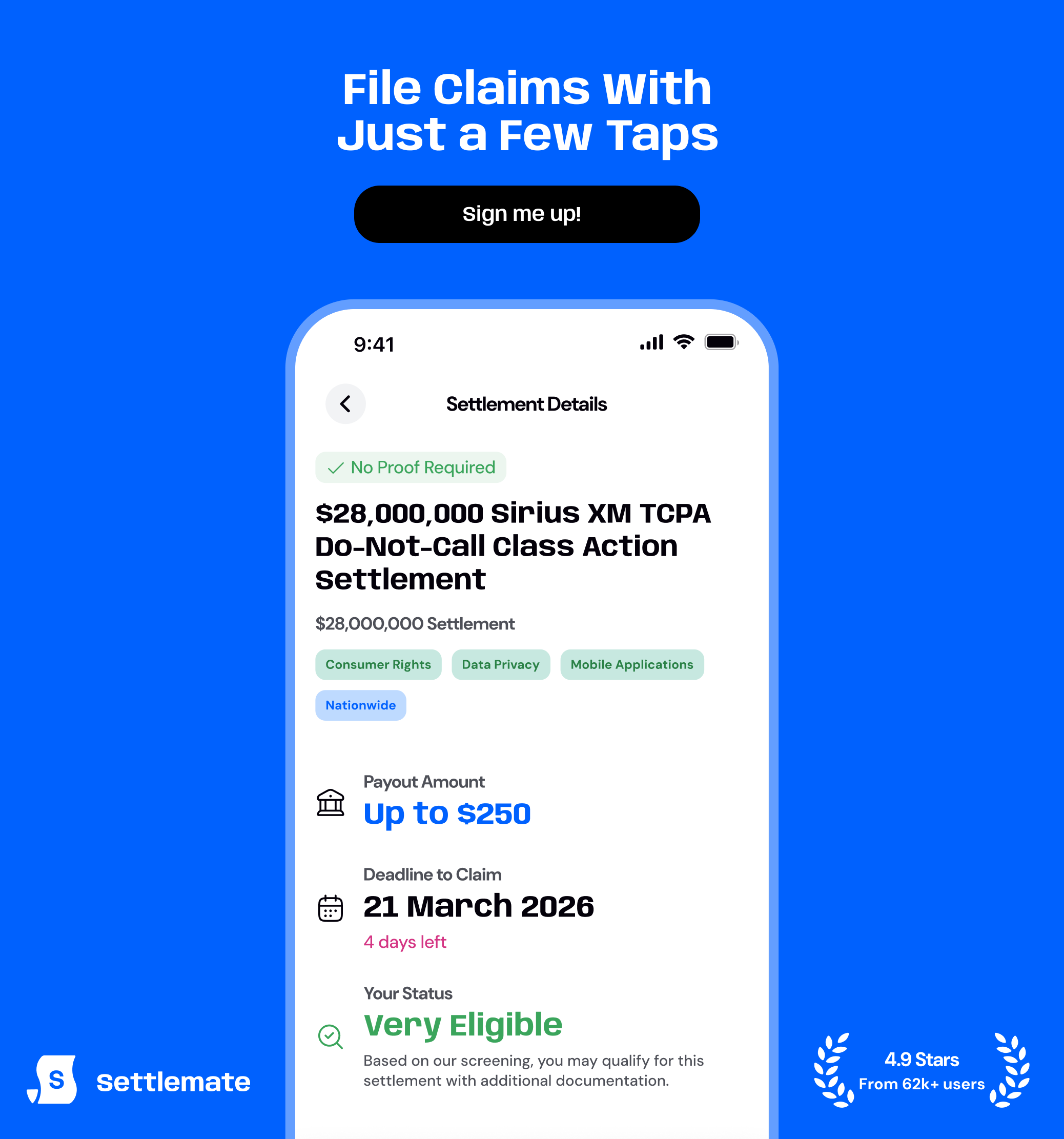
Want to give Settlemate a try? Simply download the app from App Store or Google Play, set up your account, and let the app begin scanning for eligible settlements in the background.
And there’s little risk in trying Settlemate thanks to our robust Value Guarantee. If your membership doesn’t deliver enough verified value to cover what you paid in your first 12 months, we’ll give you more time with complimentary extensions until you reach that value.
Frequently asked questions?
Is the Discover card merchant settlement legit?
Yes, the Discover credit card interchange fee settlement is legitimate. It has been formally approved by the court, and you can always check the Discover merchant settlement official site for the latest updates.
How much is the Discover class action lawsuit payout per person?
There’s no flat payout amount. What each merchant receives depends on how many Discover transactions they processed and how many valid claims are submitted overall. The settlement fund is divided proportionally among eligible claimants.
What if my business is no longer active?
An inactive business can still qualify for the Discover card class action settlement. If you can provide proof, such as old transaction statements or tax documents that show you accepted Discover cards, you may be eligible for a payout.