


According to Experian, a straightforward car insurance claim typically settles in about 15 to 30 days. But here you are, weeks or even months in, and no settlement in sight. So it’s only natural to wonder: Why is my car accident settlement taking so long?
Unfortunately, there isn’t a single reason, as several factors can stretch the timeline. Still, learning how these factors typically affect settlement timelines can make the wait feel far less arbitrary and much more predictable.
With this in mind, let’s walk through the most common reasons settlements stall and what they usually mean for your case.
Key takeaways
- Most delays are driven by medical uncertainty
Settlements usually wait until treatment stabilizes and future costs are clear. Ongoing care, serious injuries, or pre-existing conditions make it hard to value a claim accurately, so insurers would rather pause than guess.
- Paperwork moves claims more than opinions
Insurers rely on complete documentation, not explanations. Delayed medical records, missing forms, or small administrative errors can stall progress even when the facts of the accident are straightforward.
- Fault, coverage, and complexity slow everything down
Disputes over who caused the crash, which policy pays, or how multiple insurers share responsibility all require extra investigation and coordination before negotiations can move forward.
- Not every delay is bad or avoidable
Some waiting is strategic. Lawyers may delay negotiations to build leverage, strengthen evidence, or avoid settling before the full value of the claim is known.
- While you wait, protect yourself financially
Settlement timelines are unpredictable, but your finances don’t have to be. Settlemate helps you find and claim money you are already owed from class action settlements and refunds, automatically and with almost no effort, so you aren’t leaving cash on the table while your main payout is pending.
Why is my car accident settlement taking so long? 15 common causes
Delays usually stem from a handful of recurring issues that surface at different stages of the process. Below are the 15 most common ones.
1. Your injuries are still being treated
In 2023, nearly 40% of police-reported traffic crashes resulted in injuries, with about 2.44 million people injured across roughly 6.14 million crashes in the US. Given how common injuries are, it’s no surprise that medical treatment is often what determines how long a settlement takes.
Insurance companies and attorneys usually wait until you reach maximum medical improvement, meaning your condition has stabilized and further treatment is unlikely to change the outcome.
If you’re still seeing doctors, undergoing therapy, or facing possible procedures, it’s impossible to accurately calculate future medical costs or long-term impact.
Because of that uncertainty, settlement discussions often slow or pause altogether, adding months or more to the timeline. This is especially common for injuries like:
- Fractures
- Spinal injuries
- Traumatic brain injuries
- Nerve damage
2. Your medical records are delayed or incomplete
After an accident, insurers evaluate claims based on what’s documented, not verbal explanations or assumptions.
That’s why they won’t discuss settlement value until they’ve received complete medical records and bills showing the full scope of your injuries and treatment.
The problem is that hospitals, specialists, imaging centers, and physical therapists often take weeks to release records, extending your settlement timeline while paperwork catches up.

3. You’re missing required paperwork or details
Your medical documentation isn’t the only paperwork insurers rely on.
Claim forms, accident reports, authorizations, and personal details all have to be accurate and complete.
Even small errors or missing signatures can pause review and trigger follow-ups, slowing the process over administrative issues rather than the merits of your claim.
4. Your fault or liability is being disputed
In some crashes, what happened isn’t immediately clear, and that uncertainty slows everything down.
When drivers give different accounts, witness statements conflict, or multiple vehicles are involved, insurers launch deeper investigations to determine fault.
This can include:
- Reviewing police reports
- Analyzing vehicle damage patterns
- Reviewing traffic or surveillance footage
- Gathering additional evidence
- Assigning partial blame under comparative negligence rules
Until liability is resolved, settlement talks often stall, adding weeks or even months to the timeline.
5. You had a pre-existing condition
If you had prior injuries or medical conditions, insurers may argue the crash didn’t cause all of your symptoms.
This shifts the focus to medical records that separate old issues from new ones, often leading to additional reviews or independent medical exams.
Until that distinction is clear, insurers are reluctant to finalize settlement value, which slows negotiations.
6. You suffered serious or catastrophic injuries
When injuries are severe, settlements slow down because the stakes are much higher.
Long-term disabilities, permanent loss of function, or reduced earning capacity require a full accounting of future medical care, in-home support, and lifetime costs. This often requires bringing in medical specialists, life-care planners, or economic experts to document the actual value of those losses.
High-value claims also receive far more scrutiny from insurers.
A catastrophic injury case can reach eight or even nine figures—like the 2025 Texas verdict exceeding $800 million for a crash victim with permanent brain and spinal injuries. For that reason, insurers review every detail before agreeing to anything.
When the value is this high, precision matters, and rushing risks leaving substantial compensation on the table.
7. You received a low initial settlement offer
Insurance companies often start with a low offer to test how quickly you’re willing to settle.
Rejecting it usually triggers back-and-forth negotiations and requests for additional documentation to justify a higher amount.
Each counteroffer requires review and approval, which slows progress as both sides work toward a figure that reflects the true value of your claim.
8. You’re dealing with insurance delay tactics
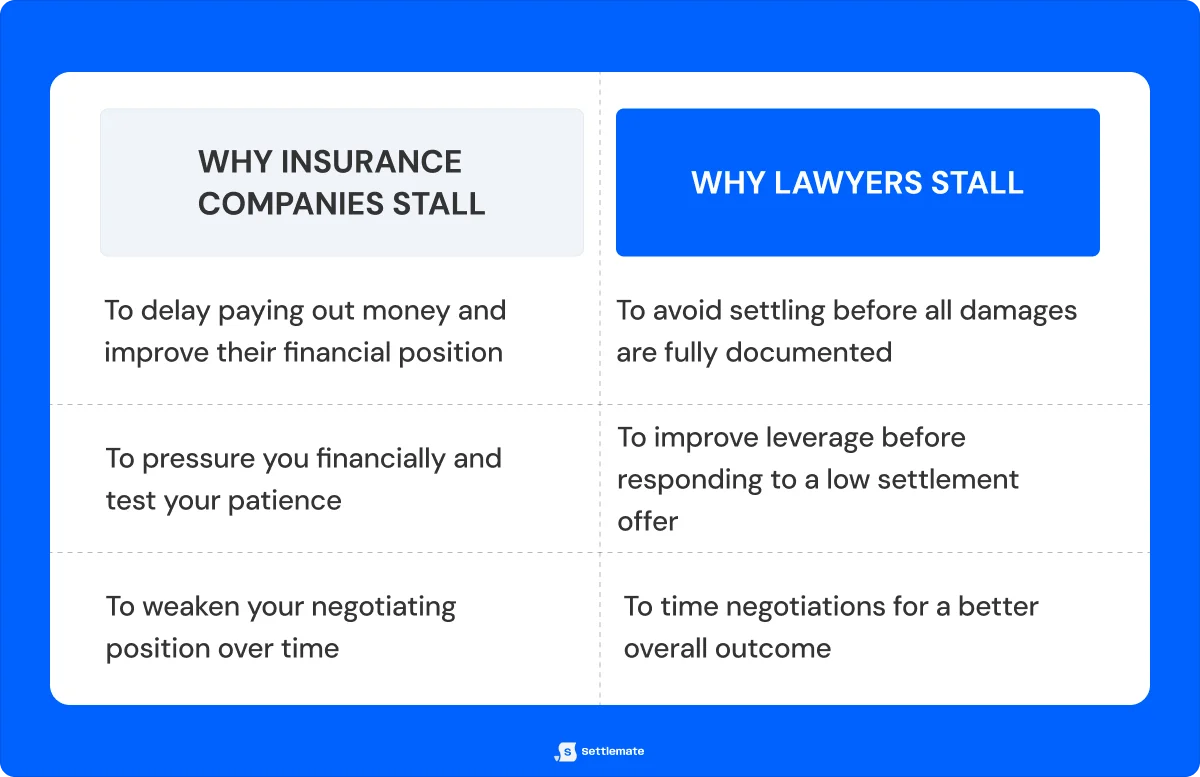
Insurance companies are businesses, and holding onto money longer often works in their favor. When a claim is costly or well-supported, some insurers slow things down deliberately to test your patience or apply financial pressure.
These delays aren’t always obvious, but they follow familiar patterns designed to drag out negotiations, such as:
- Repeated requests for documents they already have
- Long gaps in communication or ignored follow-ups
- Claims that the file is still “under review” with no clear timeline
- Disputing damages they previously acknowledged
9. You’re seeing delays caused by the negotiation strategy
Insurance companies aren’t the only ones who can intentionally slow things down. So can your lawyer(s).
In many cases, waiting is intentional because timing matters in negotiations. Accepting or countering too early—before medical records are complete or damages are fully supported—can lock you into a lower settlement than your case is worth.
Strategic delays often happen to:
- Build leverage with stronger medical or financial evidence
- Wait for treatment outcomes that clarify long-term impact
- Respond to a low initial offer with a more credible counteroffer
In other words, not every delay is a problem; some are designed to protect your outcome.
10. You’re dealing with multiple parties or insurance policies
When more than one driver, insurer, or policy is involved, settlements become slower and more fragmented, even when the underlying facts seem straightforward.
Each insurer runs its own investigation, reviews coverage limits, and decides how much responsibility it’s willing to accept. This level of coordination takes time, especially when parties disagree on who pays what or try to shift blame elsewhere.
This usually happens in cases involving:
- Multi-car pileups
- Rideshare accidents (Uber or Lyft)
- Commercial truck crashes
- Company-owned vehicles
- Uninsured or underinsured motorists
11. Your coverage or policy limits are being questioned
Even when the fault is clear, insurance coverage questions can bring everything to a halt. This typically happens when:
- The at-fault driver has low policy limits that may not cover your damages
- The other driver is uninsured or underinsured
- Multiple policies could apply, and insurers dispute who pays first
- An umbrella or excess policy needs to be reviewed
- A commercial or company policy is involved with different coverage rules
12. Your claim has entered the court system
Once a claim moves from negotiation into litigation, the timeline changes completely.
Filing a lawsuit triggers a formal court process that runs on legal schedules, not yours or the insurer’s.
Even though most cases still settle before trial, the steps required along the way take time and add layers of complexity.
This process typically includes:
- Discovery, where both sides exchange evidence
- Depositions of drivers, witnesses, and experts
- Motions and court hearings
- Mediation or court-ordered settlement talks

Court calendars, scheduling conflicts, and procedural rules all slow the pace.
While litigation can pressure insurers to negotiate more seriously, it also means progress is no longer fast or predictable.
13. Experts need time to review your case
In more complex claims, expert input is often necessary to support key parts of your case.
This can include:
- Accident reconstruction specialists to clarify fault
- Medical experts to document long-term impact
- Financial analysts to calculate lost income and future care
Their reports strengthen your claim, but gathering and reviewing that analysis takes time.
14. Communication gaps are slowing things down
Settlement progress depends on timely responses from everyone involved.
However, this isn’t always possible, as insurance adjusters often juggle heavy caseloads, medical providers may be slow to respond, and witnesses don’t always reply quickly.
Even small delays between lawyers and clients can stall momentum, causing the process to drag while everyone waits for the next response.
15. Your settlement still has to be processed
Reaching an agreement isn’t the final step.
After the terms are set, release forms must be signed, medical or insurance liens often need to be resolved, and payment has to be issued and cleared.
Each of these steps involves additional parties and approvals, which means there’s often a delay between “settled” and money actually reaching you.
How to avoid unnecessary settlement delays
Not every delay is within your control, but some are. The choices you make after an accident play a huge role in how quickly your claim moves.
The goal here is to remove avoidable friction so insurers have fewer excuses to stall, not rush a settlement at any cost.
Here’s what actually helps you achieve that goal:
What to do while you’re waiting on a car accident settlement
Car accident settlements can take months—or longer—to pay out. While that process runs its course, the smartest move is protecting yourself financially so the wait doesn’t create unnecessary pressure or force bad decisions.
One often-missed option is checking whether you’re already owed money from class action settlements, product recalls, or consumer refunds. These claims are completely separate from your accident case, don’t require hiring a lawyer, and don’t affect your settlement in any way. The problem is that most people never find them, so the money goes unclaimed.
That’s where Settlemate helps.
Settlemate works in the background to surface and collect money you’re already entitled to, by:
- Scanning your email and purchase history to identify settlements and refunds you qualify for
- Matching you with active class action settlements automatically
- Auto-filling and submitting claim forms for you
- Mailing forms when digital filing isn’t an option
- Tracking deadlines and claim status so nothing falls through the cracks
While you’re waiting on your settlement, download Settlemate on the App Store or Google Play and make good use of that time.