


You’ve just landed after an exhausting flight, and all you want is to grab your bag and leave the airport. Instead, you’re stuck at baggage claim, watching that carousel go round and round. Eventually, you give up, because your bag never arrives.
This scenario is more common than you’d imagine. The truth is that airlines mishandle millions of bags each year. You don’t just have to accept it and move on, as you might be entitled to delayed luggage compensation.
In this guide, we’ll walk you through the airline luggage regulations. We’ll discuss how these regulations differ between domestic and international flights, and what to do if your bag goes missing.
Delayed vs. lost luggage: What’s the difference legally?
Some travelers might assume that “delayed” and “lost” are interchangeable terms, but they’re not. There’s a legal difference between the two, and that difference affects the compensation you might be entitled to.
Airlines make a clear distinction between what counts as lost and what counts as delayed luggage:
Most “lost” luggage is actually just delayed. While many airlines will declare baggage lost if it’s not found within 5–14 days, the exact time frame depends on their internal policy.
Here’s how long major airlines typically search for missing bags before changing their status from delayed to lost:
- American Airlines: 5 days
- Southwest Airlines: 5 days
- Delta: 21 days
- Alaska Airlines: 6 weeks
For international flights (a flight between the United States and a foreign country), airlines adhere to the Montreal Convention 1999 (MC99). Under this regulation, bags are considered lost if they don’t show up after 21 days.
MC99 is an international treaty that sets the rules airlines must follow for situations such as lost luggage, flight delays, and passenger compensation on international routes. The treaty governs all flights across 140+ countries, including:
- The U.S.
- Canada
- Mexico
- All member states of the European Union (EU)
Can you get compensation for delayed luggage?
Yes, you have every right to be compensated for delayed luggage. The regulatory body that dictates compensation rules for domestic flights is the Department of Transportation (DOT).
If your flight disruption qualifies for compensation, airlines must reimburse you for necessary purchases (referred to as “reasonable expenses”) while your bag is delayed.
Here’s what falls under reasonable expenses:
- Toiletries: Toothbrush, toothpaste, deodorant, shampoo, razors, and other essentials
- Clothing: Basic outfits to tie you over until your bag arrives, including underwear, shirts, and pants
- Medications: Prescription refills if your medications were in checked luggage
You may also be able to get a refund for fees paid when checking your bag.
However, DOT highlights that checked luggage needs to be considered “significantly delayed” to be eligible for compensation. The length of that delay varies depending on the type of travel:
If you’re unsure how to calculate the duration of your bag’s delay, know that the delay period ends once you collect your bag at the airport or once it arrives at an address you and the airline arranged.
To get the compensation you’re entitled to, you need to file a mishandled baggage report as soon as possible.
How much compensation can you get for delayed baggage?
The compensation amount depends on several factors, including:
- Flight type
- Duration of the delay
- Items you purchased
- Maximum liability set by law
Airlines can’t limit your daily expenses to a specific amount. However, some limits do apply:
- For domestic flights: DOT regulations allow airlines to limit liability to $4,700 per person. This is the maximum, not a guaranteed amount.
- For international flights: As of 2024, MC99 sets the maximum liability at approximately 1,519 Special Drawing Rights (SDRs), which is around $2,175. This amount is reviewed every 5 years.
An exception to the domestic flights liability cap applies to assistive devices, such as:
- Wheelchairs
- Crutches
- Hearing aids
- Portable Oxygen Concentrators (POCs)
- Braces
- CPAP machines
- Medical equipment for administering medications
These items are treated differently from regular luggage when it comes to compensation. If an airline loses or destroys your assistive device, they must compensate you for the item’s full price, meaning that the standard $4,700 cap doesn’t apply. For example, if the airline loses a $20,000 wheelchair, it needs to compensate you for that full amount.
Unfortunately, the same doesn’t apply to international flights. Under the MC99, the assistive device falls under the 1,519 SDRs limit.
Exceptions to baggage fee refunds for delayed bags
Not every delayed bag qualifies for an automatic refund. Airlines aren’t required to refund baggage fees in certain situations where the delay resulted from your actions:
- You skipped the international re-check requirement: For international flights arriving in the U.S., passengers must retrieve bags at the first entry point, clear customs, and re-check them for connecting flights. If your bag is delayed because you didn’t follow this procedure, the airline isn’t responsible for the delay.
- You abandoned your bag at the airport: If your checked bag arrived on time, but you didn’t pick it up, the delay is considered your responsibility.
- You agreed to fly without your bag: Sometimes airlines offer to send your bag on a later flight so you can make your plane if you checked in late, for example. If you’ve agreed to this, you waived your right to claim the bag as significantly delayed.
Can you get compensation for lost luggage?
Yes, you can get compensated for lost luggage, potentially more than for a delayed one.
If your luggage is officially declared lost, you can claim:
- Compensation for the contents of your bag
- Refund for any fees you paid when checking the bag
The maximum liability limits for lost luggage are the same as for delayed luggage, meaning that airlines can cap liability to $4,700 per passenger for domestic flights and 1,519 SDRs per passenger for international flights.
Here’s what airlines will and won’t cover in lost baggage claims:
Airlines will likely cover expenses for:
Keep in mind that intentionally exaggerating the value of your lost bag is considered insurance fraud or fraud by false representation. To prevent fraudulent claims, airlines may request proof of value, such as a receipt for any valuables that were in your lost bag.
Note: If an airline won’t officially admit that a bag is lost even if it doesn’t appear after a reasonable amount of time, the DOT has the authority to take enforcement action.
Does travel insurance cover delayed or lost luggage?
Most comprehensive travel insurance policies cover both delayed and lost or stolen luggage. However, these function as secondary coverage and come with important caveats:
- You must first file a claim with the airline.
- Insurance covers the excess if the airline payout is insufficient.
- The insurance policy can include limits (such as electronics capped at $500).
The applicable limits differ depending on whether your luggage is lost or delayed:
Credit cards can also provide secondary baggage delay protection. To take advantage of the specific card’s feature, you need to purchase a ticket with that card.
Some of the credit cards that often include baggage insurance are:
- American Express Platinum: Up to $2,000 for checked luggage and up to $3,000 for checked and carry-on luggage
- Chase Sapphire Reserve: Up to $100 a day for 5 days for baggage delay or up to $3,000 per person for lost luggage
- Capital One: Up to $3,000 per person
Since this is also secondary coverage, you must file a claim with the airline first, and after you receive their response, submit that documentation to your credit card company.
How to submit delayed baggage compensation claims
Making a formal claim for delayed baggage compensation typically involves the following steps:
- File a Property Irregularity Report (PIR) right away: You must file this report before you leave the baggage claim area. The PIR creates an official record and generates a reference number that you’ll use for all future communication with the airline. Make sure to take a photo of your PIR or email it to yourself. This document serves as proof that you reported the issue on time.
- Document all expenses: If your bag is delayed and you need to purchase essentials, save every receipt, regardless of the amount. You can also photograph receipts in case you lose the originals. You can make a stronger case if you note what each purchase was for and why it was necessary.
- Check the filing deadline: Each jurisdiction has strict, non-negotiable deadlines. For example, the United Kingdom Civil Aviation Authority requires that you submit a claim within 7 days, while the MC99 gives you 21 days to do so. For domestic flights, the deadline depends on the airline.
- Submit the written claim via appropriate channels: Airlines have different procedures for submitting the claim, but in general, you can do it on the airline’s website. Another option might be to email the claim to the baggage claims department or send physical mail to the baggage claims office.
Be sure to submit a complete claim with all relevant information and supporting documents. For delayed luggage compensation claims, most airlines require that you supply the following:
- PIR
- Copy of your boarding pass or reservation number (you can find this number on your flight ticket)
- Baggage tag number
- Description of the bag (size, color, model)
- Destination address
- Contact details
- Receipts for “reasonable” expenses
Why do people give up on claiming airline compensation?
The uncomfortable truth about filing airline compensation claims manually is that the system is designed to make you quit.
Simply put, the process is complex and time-consuming for several reasons:
- Deadlines for submitting claims vary depending on the airline and the type of flights, and this information can be exhausting to navigate.
- It takes time (and energy) to decipher what kind of proof you need to submit.
- Every airline has its own (often confusing) policy, and it’s up to you to familiarize yourself with specific terms.
- Baggage claim departments are usually swamped with calls and may ignore your request, delay the response, or give vague rejections, prolonging the process.
These hurdles may be a lot to handle on top of dealing with the stress of missing luggage. That’s why most people give up halfway or don’t even bother to begin.
But there’s a better way. You can actually skip the hassle of dealing with airlines and navigating their regulations. Apps like Settlemate manage the entire claims process on your behalf and help you receive your rightful compensation faster.
How Settlemate puts your baggage compensation claim on autopilot
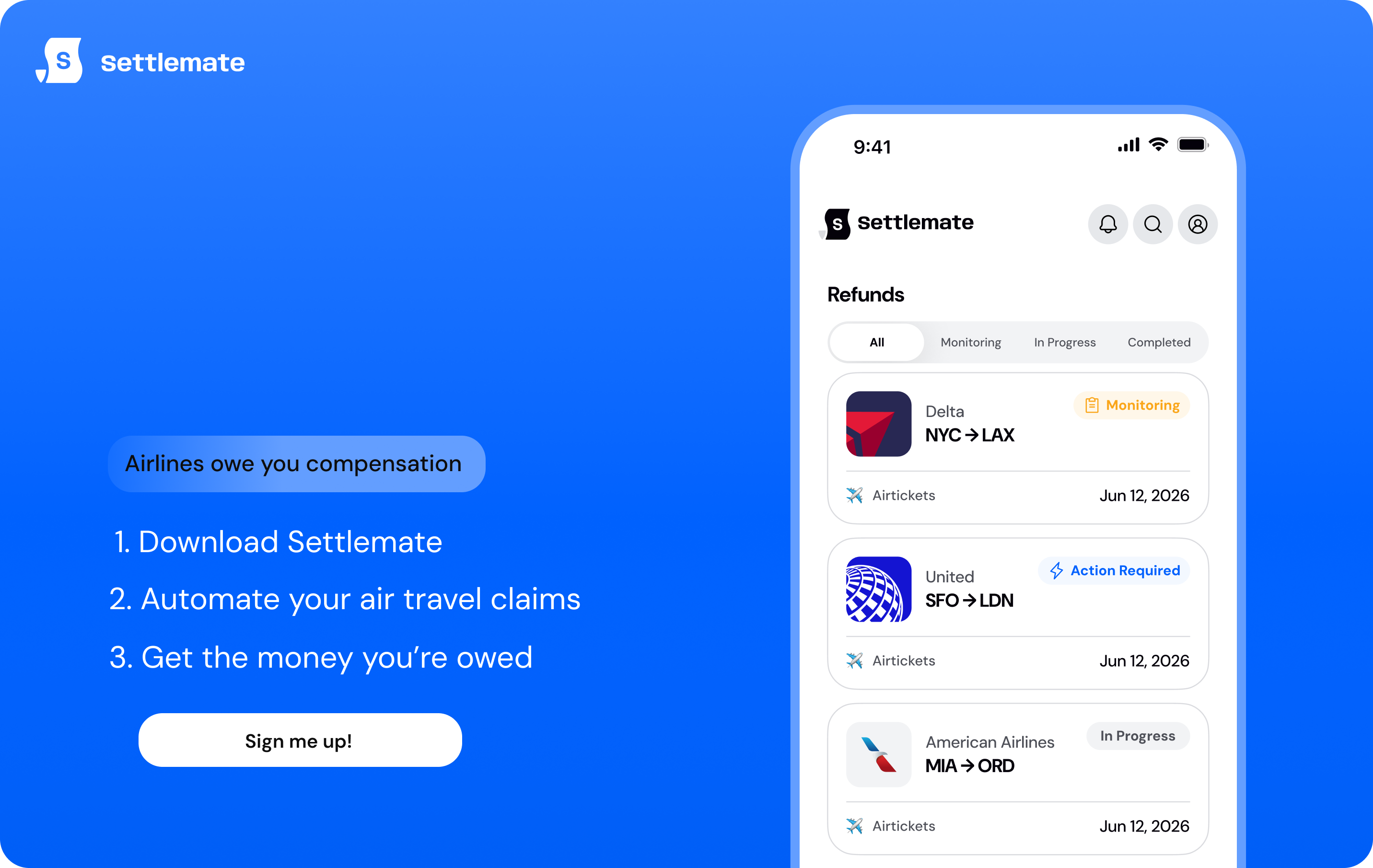
You can forget about digging through airlines’ policies, stressing about deadlines, or trying to figure out what documentation to send. Settlemate’s Autopilot feature handles it for you.
Once you connect your email, Settlemate monitors for baggage issues automatically. When your bag doesn’t show up, the app detects it from the airline notification and takes the process from there.
Here’s how Settlemate works:
- Automatic detection: Settlemate scans for PIR, delay notifications, and baggage claim references in your inbox.
- Smart prompts: The app guides you through what to upload, whether that’s PIR, flight details, or receipts, depending on what the airline requires.
- Automated claims: Settlemate generates a structured claim and submits it on your behalf. If there’s an airline-specific form, the app guides you to it.
- Follow-up handled: If the airline doesn't respond, Settlemate follows up for you.
- Progress notifications: The app will notify you about every phase of the process, including if your compensation is approved, a refund has been issued, or additional documentation is needed.
Settlemate also works alongside your credit card benefits, so you can take advantage of both. The app flags when you’re eligible for credit card reimbursement and prompts you to file the required documents.
Additionally, the app tracks every opportunity to get you compensation, including:
- Diverted flights
- Airlines changing flights
- Missed connections
- Airlines trying to push vouchers instead of giving you cash
- Seat downgrades
- Rebooking flights at cheaper fares
Get started with Settlemate today. Download the Settlemate app from the App Store or Google Play and let us handle baggage claims while you focus on your next trip.
Settlemate is a risk-free experience thanks to its Value Guarantee. If your membership doesn’t deliver enough verified value to cover what you paid in your first 12 months, we’ll give you more time with complimentary extensions until you reach that value.
Frequently asked questions
Can I claim delayed baggage compensation if I didn’t keep my receipts?
If you don’t have receipts, try to find alternative proof, such as credit card statements. In case you don’t have any evidence, you can still file a claim, but the reimbursement may be significantly reduced.
Do I need travel insurance if airlines already compensate for lost bags?
Travel insurance provides additional coverage and covers scenarios outside of the airline’s care, like theft from hotel rooms or lost items. When it comes to lost or delayed bags, travel insurance provides secondary coverage, meaning that it covers remaining costs up to the policy limit.
What happens to luggage if a flight is delayed?
If you experience a flight delay while remaining on the same aircraft, your luggage will usually stay on board and arrive with you. If the delay causes you to miss a connecting flight, your bag may be rerouted on a later flight and arrive separately. In that case, you’ll need to file a baggage delay report.
Which airline companies offer flight compensation?
Every airline has its own compensation rules. Whether your flight got delayed or canceled, these guides can tell you what you might be entitled to depending on the airline: